
Winter has not yet fully set in, yet the air across several Indian cities is already becoming increasingly toxic. The rapidly deteriorating air quality in Delhi-NCR and several parts of northern India is a stark reminder that air pollution is no longer merely a seasonal problem. It has become a serious challenge confronting environmental governance, urban development and public health. Every year, October and November bring a familiar nightmare: suffocating smog, burning eyes, breathing difficulties and a surge in hospital admissions. The irony is that despite knowing the causes of this recurring crisis and having access to solutions, we appear condemned to relive the same ordeal year after year. The pressing question is this: Will breathing clean air soon become a rare privilege rather than a basic right of every citizen?
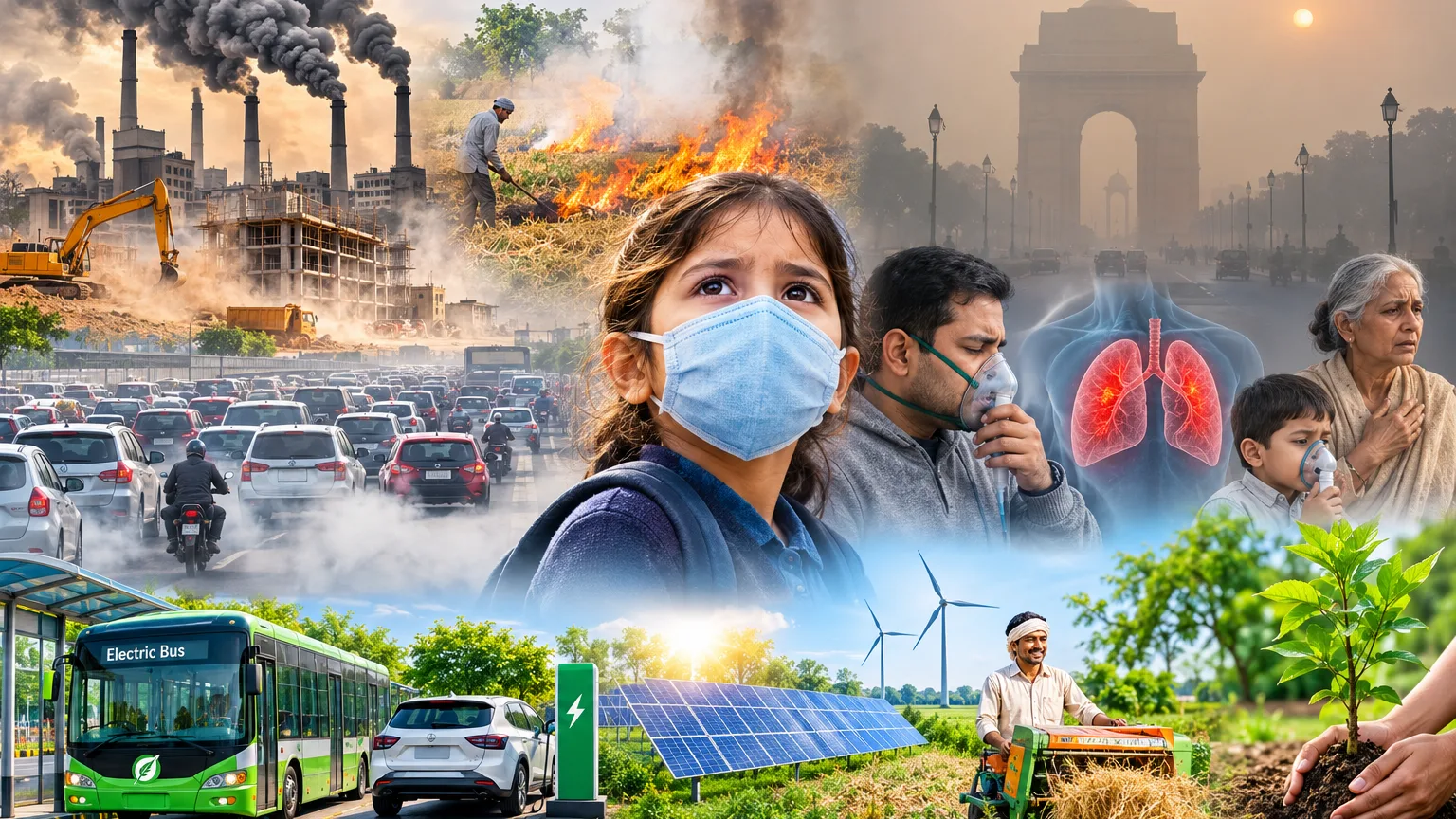
Air pollution cannot be attributed to a single cause or blamed on any one state. Vehicular emissions, industrial pollutants, dust from construction sites, accumulated road dust, the burning of garbage and organic waste, emissions from thermal power plants, and the burning of agricultural residue are among its principal sources. During winter, falling temperatures, slower wind speeds and unfavourable atmospheric conditions can trap pollutants close to the ground, intensifying their concentration and harmful effects. Weather may aggravate the crisis, but its underlying causes are largely rooted in human activity and inadequate regulation. The problem, therefore, is not simply a consequence of changing seasons; it reflects deeper failures in environmental management, urban planning and the enforcement of pollution-control measures.
Delhi-NCR offers one of the clearest illustrations of this crisis. Delhi, Ghaziabad, Noida, Greater Noida, Gurugram, Faridabad and numerous surrounding areas form an interconnected airshed. Consequently, measures confined to Delhi's administrative boundaries cannot deliver a lasting solution. Air does not recognise political or administrative borders; pollutants travel freely from one region to another, carrying their harmful effects with them. The response must, therefore, be equally comprehensive, based on regional cooperation, shared accountability and a coordinated action plan. Fragmented policies and the shifting of blame between neighbouring states will only prolong the crisis. What is required is a unified approach that addresses pollution at its source and ensures accountability across the entire region. The most alarming dimension of air pollution is its devastating impact on human health. Fine particulate matter, particularly PM2.5, can penetrate deep into the lungs and, under certain conditions, enter the bloodstream. Prolonged exposure increases the risk of cardiovascular and respiratory diseases, strokes and premature death. Children, older people, pregnant women and individuals with pre-existing health conditions are especially vulnerable. The consequences, however, extend far beyond those already suffering from respiratory ailments. Even people who appear healthy may experience reduced productivity, impaired concentration and a diminished quality of life.
When children are prevented from playing outdoors, elderly people are forced to abandon their morning walks, and workers must earn their livelihoods while breathing polluted air, the issue ceases to be merely an environmental concern. It becomes a question of human dignity and the fundamental right to health. Clean air is essential to a life of safety, well-being and dignity. Air purifiers and face masks may offer a degree of protection under certain circumstances, but they cannot substitute for a public system that guarantees cleaner air. Citizens should not be forced to purchase individual protection against a hazard that demands collective action and effective public policy. Whenever pollution levels rise to dangerous levels, the Graded Response Action Plan (GRAP) becomes an essential instrument for controlling the crisis. Depending on the severity of pollution, it provides for restrictions on construction activities, controls on vehicles and industries, and other emergency measures. However, the effectiveness of such interventions depends not merely on issuing orders but on their rigorous implementation, continuous monitoring and strict enforcement. If construction sites continue to generate clouds of dust, waste continues to be burned in the open, and restrictions are routinely violated, government announcements cannot produce the desired results. A policy that exists only on paper cannot protect a single breath.
The government must stop waiting for pollution to reach catastrophic levels before responding. Preparations should begin as early as September and October, well before the winter crisis peaks. Pollution sources must be identified in advance, industrial units inspected, roads cleaned regularly, dust-control measures enforced at construction sites, and vehicular emissions checked systematically. Strengthening public transport, expanding electric bus services, accelerating the transition to cleaner energy and taking impartial action against polluting industries must form part of a sustained, long-term strategy. Preventive action, rather than emergency firefighting, should become the guiding principle of pollution management.
The challenge of crop-residue burning also demands a practical, sensitive and farmer-centric approach. Merely imposing fines on farmers will not eliminate the problem. Farmers must be provided with affordable machinery, technical assistance, financial incentives and accessible local facilities for managing agricultural residue. Viable alternatives must be made economically and operationally feasible. Farmers should not be treated merely as contributors to the problem; they must be empowered as essential partners in its solution. Lasting change will come not through punitive measures alone, but through cooperation, technological support and policies that recognise the economic realities of agriculture. Pollution control, however, is not the government's responsibility alone. Citizens, too, must acknowledge their role in protecting the environment. Unnecessary use of private vehicles should be reduced, public transport encouraged, garbage and fallen leaves should not be burned, and energy must be used more efficiently. Reporting violations of environmental regulations to the relevant authorities and participating in local cleanliness drives and initiatives to expand green spaces are equally important. The media, educational institutions and social organisations must intensify public awareness campaigns so that the importance of clean air is not remembered only when pollution reaches its annual peak. Environmental consciousness must become a year-round civic responsibility rather than a temporary reaction to an emergency.
At the same time, air-quality data must be made available to the public in a transparent and accessible manner. Citizens should receive timely, clear and scientifically sound health advisories corresponding to pollution levels. Schools, hospitals, workplaces and local administrations must be adequately prepared to respond when air quality deteriorates. Reliable information and early warnings can help people take precautions, but these measures must complement—not replace—decisive action to reduce emissions at their source. Experiences from cities such as Beijing in China demonstrate that sustained policy interventions, cleaner transport systems, industrial emission controls and effective monitoring can bring about significant improvements in air quality. India must draw relevant lessons from such experiences and adapt them to its own geographical, economic and social conditions. The scale of the challenge demands continuity of policy, scientific planning, technological innovation and firm political will. Short-term restrictions may help contain an immediate emergency, but only structural reforms can prevent its annual recurrence.
It is deeply troubling that every winter, millions of people are forced to struggle against polluted air, only for the issue to recede from public attention when the weather changes. No sensitive society can accept such a cycle of suffering, neglect and renewed crisis as inevitable. Clean air is not a luxury reserved for the privileged; it is a fundamental necessity of life. When the air itself becomes a threat to health, the cost is measured not merely in economic losses or administrative failures, but in human suffering, diminished well-being and lives cut short. If decisive measures are not taken today, future generations will be compelled to pay a far heavier price. The battle against pollution must begin before the crisis deepens, not after the skies have turned grey and the air has become unbreathable. Governments must demonstrate foresight, administrations must ensure accountability, industries must adopt responsible practices, farmers must receive meaningful support, and citizens must embrace environmental responsibility.
The way forward lies in a powerful convergence of proactive governance, accountable administration and informed public participation. Only through this collective resolve can we move beyond seasonal promises and emergency restrictions towards a lasting solution. The true measure of development is not merely the height of our buildings, the speed of our roads or the expansion of our cities, but the quality of life they offer their people. Ultimately, a nation cannot aspire to a healthy, prosperous and developed future if its citizens cannot breathe safely in the present. The right to breathe clean air must not remain a promise renewed every winter; it must become a reality protected every day of the year.