

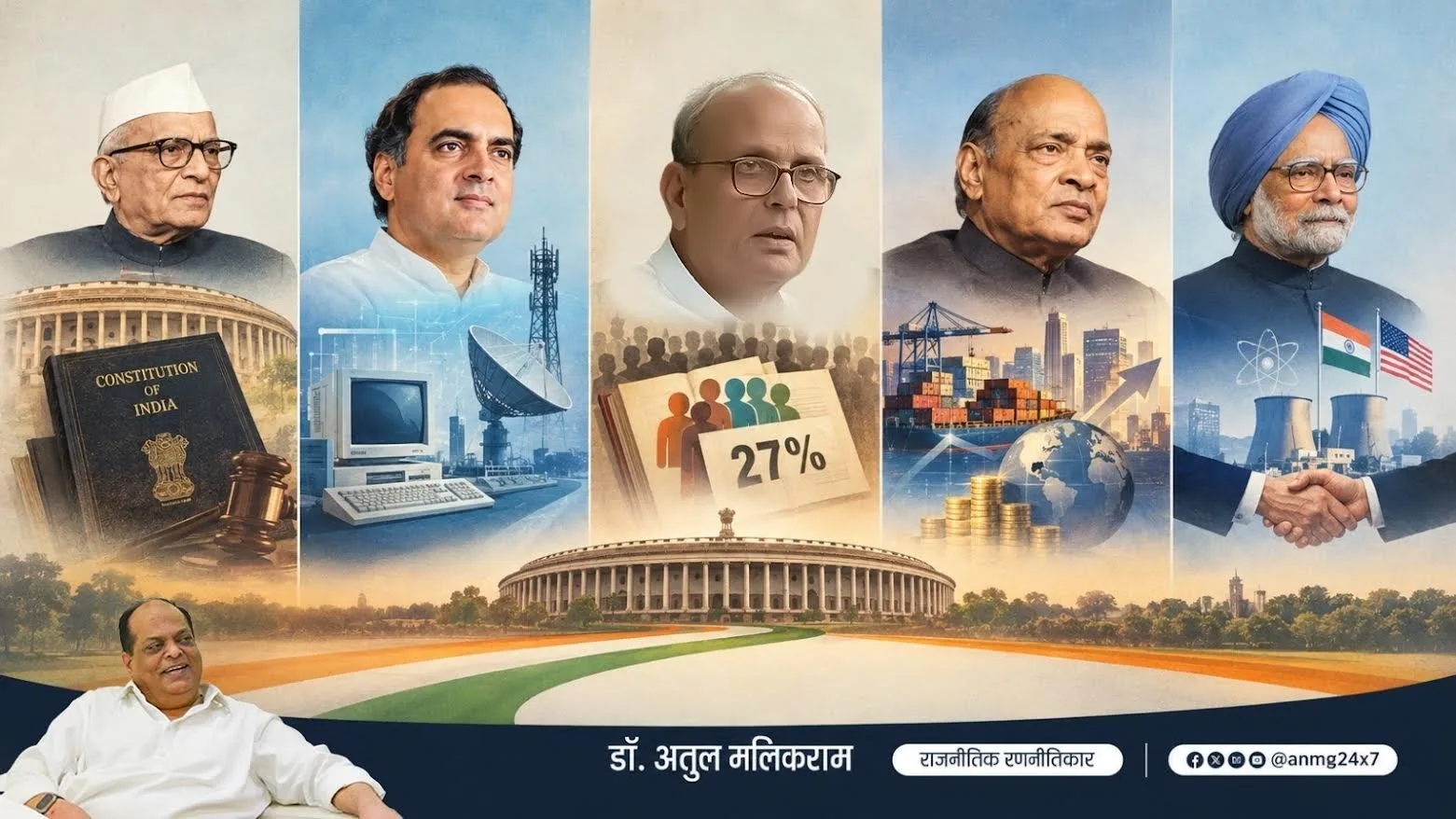
The Emergency imposed in India from June 25, 1975, to March 21, 1977, remains a defining chapter in the country's democratic history. Its aftermath brought a change in government and opened the way for new approaches to governance, social justice, technological development and economic policy. Since 1977, several decisions by successive prime ministers have had an impact far beyond the political circumstances in which they were taken. Their historical significance lies not merely in who made them, but in how they influenced the direction of India's institutions, society and economy. Morarji Desai: Strengthening Democratic Institutions In March 1977, the Janata Party government led by Morarji Desai came to power. One of its biggest challenges was to restore public confidence in democratic institutions following the Emergency. The 44th Constitutional Amendment, enacted in 1978, was an important step in this direction. It introduced safeguards to make the declaration of an Emergency more difficult and strengthened protections for civil liberties. It also ensured that the rights to life and personal liberty under Articles 20 and 21 could not be suspended during a national Emergency. Desai's public emphasis on democratic freedoms, including press freedom, became an important part of his government's legacy. Its contribution was significant because it sought to make the change of government more than a political transition by linking it to constitutional accountability and safeguards against the misuse of power. Rajiv Gandhi: Laying the Foundations for Technological Modernisation During the 1980s, India began changing its approach to computers and telecommunications. Under Prime Minister Rajiv Gandhi, technological modernisation became a government priority. The establishment of the Centre for Development of Telematics (C-DOT) in 1984 and Mahanagar Telephone Nigam Limited (MTNL) in 1986 marked important steps towards expanding telecommunications infrastructure. The 1986 software policy also helped encourage software development and exports. Efforts to develop indigenous telecommunications technology, expand computer usage and improve communication networks laid important foundations for India's subsequent growth in information technology. The larger significance of these initiatives was the changing perception of technology. Rather than treating it as a specialised industrial activity, the government increasingly recognised it as an instrument of national development and economic transformation. V. P. Singh: Bringing Social Justice to the Centre of National Politics On August 7, 1990, Prime Minister Vishwanath Pratap Singh announced the implementation of the Mandal Commission's recommendations to provide 27% reservation for socially and educationally backward classes in central government jobs. The commission had submitted its report in 1980. The announcement triggered nationwide debate, protests and a major realignment of Indian politics. In 1992, the Supreme Court, in the Indra Sawhney case, upheld the framework for reservation while laying down important conditions, including the exclusion of the creamy layer among Other Backward Classes. The decision brought questions of representation, equal opportunity and social justice to the forefront of national politics. It also contributed to the growing political participation of backward communities and reshaped debates about access to public employment and representation in government institutions. P. V. Narasimha Rao: Transforming India's Economic Policy While the debate over the Mandal Commission was unfolding, India faced a severe balance-of-payments crisis in 1991. Foreign exchange shortages, external pressures and economic uncertainty created an urgent challenge for the government. Under Prime Minister P. V. Narasimha Rao and then Finance Minister Dr Manmohan Singh, India introduced a new industrial policy on July 24, 1991. The reforms moved towards ending industrial licensing in most sectors, encouraging foreign investment and reducing government controls over economic activity. These measures initiated a broader process of economic liberalisation and helped make the Indian economy more competitive. The transformation went beyond a single policy announcement, redefining India's approach to industry, trade, investment and engagement with the global economy. The 1991 reforms remain a landmark in India's economic history because they set the country on a path towards greater market orientation and deeper integration with international markets. Manmohan Singh: Redefining India's Strategic and Educational Landscape The civilian nuclear cooperation initiative announced by India and the United States in 2005 was among the most consequential strategic decisions of Prime Minister Manmohan Singh's tenure. Following a special waiver granted to India by the Nuclear Suppliers Group in 2008, the agreement opened the way for international civilian nuclear trade and cooperation. India secured this arrangement without signing the Nuclear Non-Proliferation Treaty (NPT), making it a significant development in the country's foreign policy and pursuit of strategic autonomy. The agreement generated intense political debate at home, and the government faced a parliamentary confidence vote amid the controversy. Nevertheless, the government pursued the initiative. Manmohan Singh's tenure also saw significant developments in educational access and representation. The 93rd Constitutional Amendment enabled special provisions for the advancement of socially and educationally backward classes and other specified groups in educational institutions. Its implementation was followed by the introduction of OBC reservations in central educational institutions, expanding the debate over representation and access to higher education. The Lasting Impact of Historic Decisions The historical importance of these five sets of decisions should be assessed through their long-term consequences rather than their immediate political gains or losses. Constitutional safeguards, technological modernisation, social representation, economic liberalisation and strategic diplomacy have each influenced India's trajectory at different stages of its development. A prime minister's legacy cannot be judged solely by popularity or the duration of a government. History ultimately evaluates leadership by how decisions strengthen institutions, expand opportunities and create possibilities for future generations. These milestones demonstrate how policy choices made in response to the challenges of their time can shape the direction of a nation for decades.
India
Five Prime Ministers Who Shaped India's Destiny Through Historic Decisions
Dr Atul Malikram, Political Strategist
Related stories

Afreximbank and partners advance Africa’s automotive investment agenda at Alamein Africa Forum
CAIRO -- African Export-Import Bank (Afreximbank) (www.Afreximbank.com), in partnership with the African…

Vijayadashami is a festival celebrating the victory of truth and justice – Shri Devnani
Jaipur. Rajasthan Legislative Assembly Speaker Vasudev Devnani has extended his greetings and best wishes to…

How Long Will Human Lives Continue to Be Swept Away in the Tidal Wave of Faith?
The news of the stampede at the public Durga Puja pandal in Chorbagan, Kolkata, during the Durga Puja celebra…

Dussehra: The Victory of Light Within — From Self-Conquest to National Awakening
One of the greatest strengths of Indian culture is that it has never confined festivals to joy, celebration a…