.png)

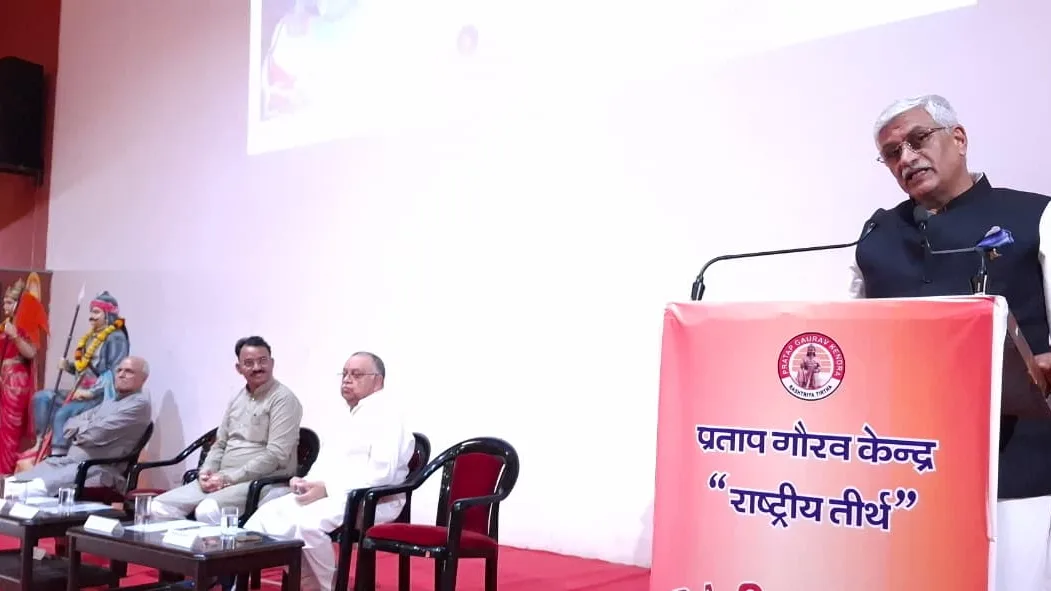
Udaipur. “Water conservation should be an integral part of our lifestyle and daily conduct. It is essential that we develop respect toward natural water sources,” stated Dr. Shrikrishna ‘Jugnu’, noted scholar of Indian knowledge traditions, while addressing a national seminar on “Water Conservation in World Culture: A Discourse” organized by Banaras Hindu University (BHU).
The event was held under the aegis of the Department of History and the Faculty of Social Sciences. In his online lecture, Dr. Jugnu highlighted ancient Indian scriptures related to meteorology, water source sciences, and groundwater systems, along with the oral traditions that preserved this knowledge through generations.
He remarked that Rajasthan has been naturally endowed with the virtue of water conservation. “Here, people do not need to be told to ‘save water,’ for scarcity itself has made it sacred. As a local proverb goes, ‘If ghee spills, nothing is lost, but if water spills, life itself burns.’ Even camels—known as the ships of the desert—can go days without drinking water and yet survive,” he explained.
Dr. Jugnu emphasized that Rajasthan’s settlements have historically developed around various types of water sources—ponds, wells, lakes, stepwells, and tanks, reflecting an advanced understanding of water management. “This is the land where the most extensive and diverse treatises were written not only on rain and water conservation but also on the creation, development, and restoration of water bodies,” he said, noting that no two structures here resemble each other in design or concept.
He also mentioned the traditional experts still found in Rajasthan: Garbi, who predict rainfall patterns; Harwa, who locate underground water veins; and Agla, who identify surface water zones. “Our water science tradition is as rich in written form as it is in oral and hereditary practice,” he added.
Referring to ancient texts—from Saraswat Muni’s Jalargal and the verses of Parashar and Kashyap, to Aparajita’s directives and Ojha Ji’s Kadambini—Dr. Jugnu described them as part of India’s vast system of indigenous knowledge.
The session concluded with Dr. Seema Mishra, organizing secretary, and Ashok Kumar Sonkar, coordinator from BHU, expressing their gratitude to Dr. Jugnu for his enlightening address.