.png)
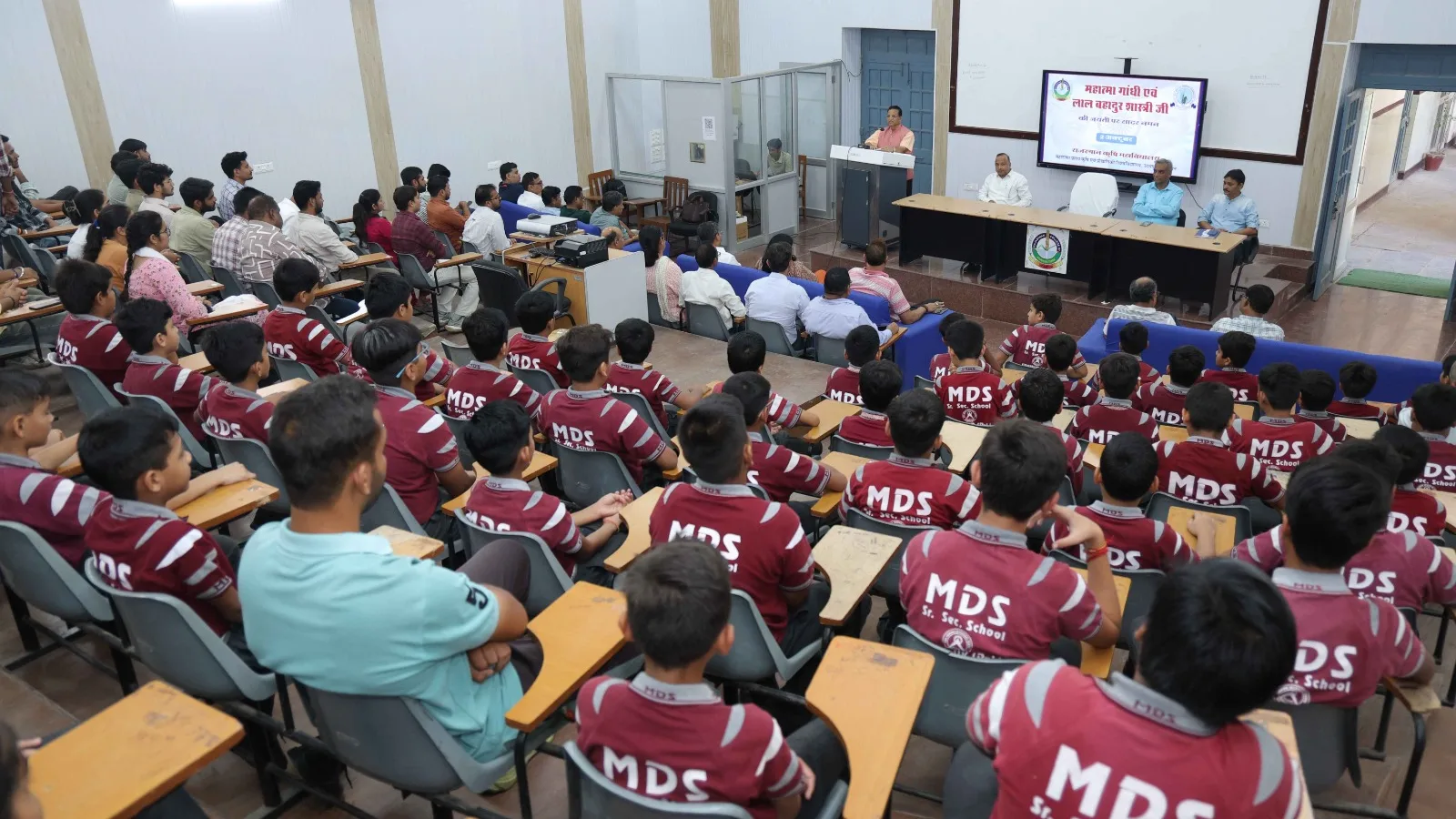
Udaipur: Rajasthan College of Agriculture, a constituent college of Maharana Pratap University of Agriculture and Technology (MPUAT), Udaipur, organised a floral tribute and prayer meeting at the IPM Theatre to mark Gandhi Jayanti and the International Day of Non-Violence.
MPUAT Vice-Chancellor Dr. Pratap Singh, in his address, recalled Mahatma Gandhi’s ideals of truth and non-violence and highlighted their relevance to the nation’s journey towards agricultural self-reliance.
The programme also remembered the life, ideals and contributions of Mahatma Gandhi and former Prime Minister Lal Bahadur Shastri to nation-building. Students, agricultural scientists and faculty members paid floral tributes and pledged to uphold Gandhi’s message of truth and non-violence as well as Shastri’s call of “Jai Jawan, Jai Kisan.”
Speakers said October 2 was not merely a ceremonial occasion but an opportunity to reflect on the contributions of two of India’s great leaders. While Gandhi showed the nation the path of truth and non-violence, Shastri placed farmers and soldiers at the heart of nation-building.
The programme also highlighted India’s journey towards agricultural self-sufficiency. Speakers recalled that during the 1960s, India depended heavily on food imports and foreign assistance. Shastri encouraged farmers to increase agricultural production, while subsequent efforts by Agriculture Minister C. Subramaniam, scientists, Dr. M.S. Swaminathan and others, along with the contribution of Norman Borlaug, helped lay the foundation for the Green Revolution.
The Green Revolution, speakers noted, went beyond increasing crop production. Institutions and systems such as the Food Corporation of India (FCI), Minimum Support Price (MSP), Commission for Agricultural Costs and Prices (CACP), storage and transportation infrastructure, and the National Dairy Development Board (NDDB) helped strengthen the agricultural value chain. These efforts played a significant role in making India self-reliant in foodgrain production and capable of meeting the food requirements of its large population.
The speakers also discussed emerging challenges facing Indian agriculture, including climate change, erratic monsoons, extreme heat, declining groundwater levels, pests and diseases, and rising input costs. They stressed the need to strengthen small and marginal farmers through access to quality seeds, remunerative prices, credit, insurance, markets and storage facilities.
Addressing agricultural scientists and students, speakers emphasised that the role of agricultural universities and research institutions should extend beyond laboratories. Under the “Lab to Land” approach, scientific technologies must reach farmers and address their practical field-level challenges. The need to protect farmers from spurious agricultural inputs and ensure access to quality production materials was also emphasised.
Speakers further stressed that farmers are the first link in the agricultural value chain and that policies and systems should strengthen their income, productive capacity and access to markets. Agricultural scientists, students and officials associated with the agriculture sector were urged to work collectively in the interest of farmers.
College Dean Dr. Lokesh Gupta paid floral tribute to Mahatma Gandhi and Lal Bahadur Shastri and recalled their sacrifices and contributions to the nation. He called upon the gathering to follow the path of truth and non-violence shown by Gandhi. He also highlighted Shastri’s contribution to laying the foundation for the Green and White Revolutions, which helped India achieve greater self-sufficiency in food production.
Assistant Dean, Student Welfare, Dr. Kapil Dev Ameta, also paid tribute to the two national leaders and remembered their sacrifices. He expressed gratitude to the students from MDS School and all those who attended the programme.
Senior faculty members, heads of departments, employees and students of the college were present on the occasion. The programme concluded with a pledge to uphold the ideals of truth, non-violence, self-reliance and Gram Swaraj and to contribute towards building a developed and self-reliant India.
The gathering resolved to work together “for the farmer, for the village and for the nation,” strengthening every link of the agricultural and rural development chain.