

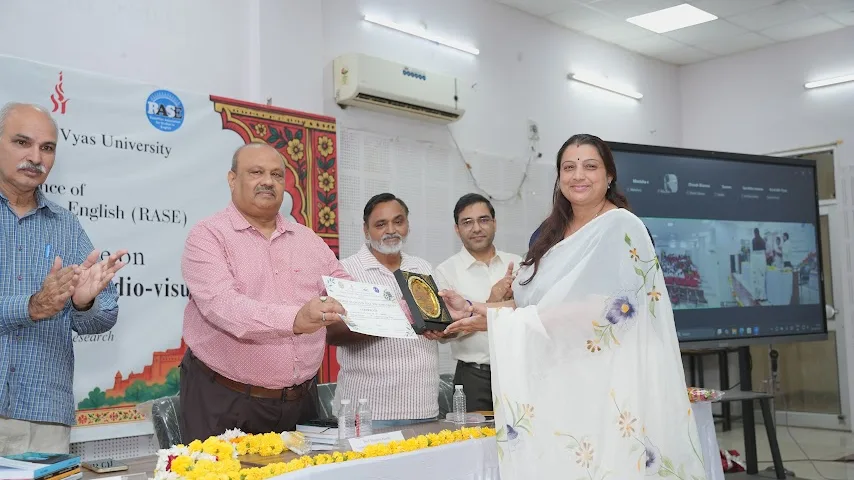
Multilingual Traditions Sustain Culture: Prof. Ganesh Devy Jodhpur: The inaugural ceremony of the international conference on “Narrative Nuances in Text and Audio-Visuals” was held on Friday, October 23, at the Golden Jubilee Auditorium of Jai Narain Vyas University, Jodhpur. The inaugural session was presided over by the Vice-Chancellor, Prof. Pawan Kumar Sharma. The Chief Guest was the renowned linguist and Padma Shri awardee Prof. Ganesh Devy, who was honoured with the Sahitya Akademi Award for his contribution to literary criticism. In his address, Prof. Devy observed that political power was under the control of corporate interests, which were replacing actual reality with virtual reality. In this process, unnatural rationality was being normalised in place of fundamental human sensibilities, while violence was being justified. He remarked that, in contemporary times, memory was being given precedence over imagination. This was an age in which the narrative promoted by those in power was being imposed upon the narratives of ordinary people. He emphasized that India could retain its true identity only as long as plurality of narratives remained protected. Giving prominence to a single narrative at the expense of narrative plurality would be contrary to the very nature of India. He also expressed concern over the growing tendency towards the extinction of languages. He observed that such tendencies might produce citizens of a nation, but they could never create citizens of a civilisation. The Guest of Honour, Prof. Rajul Bhargava, President of the Rajasthan Association for Studies in English, remarked that the most significant aspect of narration was its flexibility. Innovative modes of pronunciation and variations in vocal pitch and intonation enhanced the quality and richness of meaning. Prof. Vic Gaffney from Australia observed that diverse uses of words, alongside their literal meanings, enriched the aesthetic appeal of language and literature. Prof. Evgenia Zharikova from Russia stated that different styles of narration generated new meanings across languages, countries and cultural contexts. Introducing the theme of the conference, Prof. Hemendra Chandalia, Vice-President of the Association, observed that oral traditions could give rise to multiple creative versions of a single story. Despite their diverse narrative forms, these stories had remained acceptable across different sections of society. This, he noted, represented the strength of diversity inherent in Indian culture. The General Secretary of the Association, Dr. Khushwant Singh Kang, presented the annual report. The Head of the Department, Prof. Satish Harit, delivered the welcome address, while the Organising Secretary, Dr. Vivek Paharia, proposed the vote of thanks. On the occasion, the conference souvenir, the Association's journal, and books authored by Dr. Vivek Pahadia and Vikas were formally released. Dr. Seema Soni, Organising Secretary of the previous year's conference, was also felicitated. The keynote address was delivered by Prof. Nandini Sahu, Vice-Chancellor of Hindi University, Kolkata. In her address, she explained the diverse forms of narration in folk and classical traditions and discussed the complexities of narratives emerging through contemporary virtual media. She observed that technology had simplified the essential requirements of oral narration, while audio-visual media had enhanced its imagery and musicality. The session was chaired by Prof. Bishwajoy Chatterjee, Vice-Chancellor of the University of Engineering and Management, Jaipur. Special Lectures and Academic Sessions Prof. Ashutosh Mohan of Guru Gobind Singh Indraprastha University, New Delhi, delivered the Prof. S. N. Joshi Memorial Lecture. This lecture is organised annually in memory of the Association's Founder President, Prof. S. N. Joshi. The session was chaired by Prof. Rajkumar Verma of the University of Delhi. In the afternoon, Prof. Bishwajoy Chatterjee, Vice-Chancellor of the University of Engineering and Management, delivered a special lecture on the application of Artificial Intelligence (AI) in the field of literature. The session was chaired by Prof. Rajul Bhargava. Second Day of the Conference: Exploring the Intersections of Literature, Cinema and Digital Media The second day of the international conference on “Narrative Nuances in Text and Audio-Visuals”, held on Saturday, witnessed extensive deliberations on the interrelationships between literature, cinema and digital media. Scholars and researchers from India and abroad presented their research on the changing modes of storytelling, ranging from traditional literary writing to contemporary audio-visual media. Eight technical sessions were conducted throughout the day. Major discussions focused on the cinematic adaptations of literature, the language of sound and silence in Indian cinema, and the narrative techniques of graphic novels and comics. Contemporary issues such as Dalit and feminist discourses, the trauma of Partition, memories of migration, Indian knowledge traditions, ecology, and the democratisation of writing through Artificial Intelligence (AI) and social media were also discussed. One of the major attractions of the second day, held at the Golden Jubilee Auditorium, was the musical presentation by Dr. Sanchita Chaudhary, Director of the Rourkela-based institution Hum Nishad. As the keynote speaker of the second plenary session, Dr. Chaudhary delivered a highly engaging lecture on “The Role of Sound, Music and Memory in the Art of Storytelling.” She explained that memories are essentially audio-visual in nature and that music is one of the most powerful mediums for transcending geographical boundaries and connecting emotions with personal memories. Drawing upon various ragas of Indian and Western musical traditions, she demonstrated how compositions based on the same raga could be presented in different ways to evoke diverse emotions. Her musical performances on the harmonium captivated the audience. This was followed by a panel discussion in which subject experts engaged in a dialogue on the challenges confronting contemporary literature and cinema. Dr. Vijay Mangukiya, Dr. Narendra Tiwari and Prof. Satish Harit shared their perspectives during the session, which was chaired by Prof. Anjana Srivastava of Kamala Nehru College, University of Delhi. The special evening session, titled “Meet the Author and Storytelling,” provided an opportunity for international academicians from India, Australia, Russia and Nepal to share their creative experiences. The participants included Prof. Vic Gaffney from Australia, Prof. Evgenia Zharikova from Russia, Dr. Paritosh Duggar and Prof. Birendra Pandey of Tribhuvan University, Nepal. During the organisational session of the Rajasthan Association for Studies in English, elections for the new executive body were conducted. Prof. Sanjeev Kaushal of the University of Delhi and Dr. Sanchita Choudhury, Director of Hum Nishad, Rourkela, Odisha, were elected as Vice-Presidents. Dr. Vivek Paharia, Assistant Professor, Department of English, Jai Narain Vyas University, Jodhpur, and Dr. Manoj Kumar, Assistant Professor, Amity University, Jaipur, were elected as members of the Executive Committee. The session was chaired by the President of the Association, Prof. Rajul Bhargava, and conducted by Vice-President Prof. Hemendra Chandalia. These elections are expected to bring renewed energy and diverse experiences to the Executive Committee. The meeting also discussed forthcoming academic programmes, collaborative projects and strategies for enhancing the visibility of English Studies in Rajasthan. Valedictory Ceremony: Three-Day International Conference Concludes The three-day international conference on “Narrative Nuances in Text and Audio-Visuals” concluded on Sunday, October 25, with a grand valedictory ceremony. Before that two plenary sessions were held . The first one was addressed by Prof. Dev Vrat Sharma. This session was chaired by Prof. A.K.Shrivastav. The second plenary lecture was delivered by Dr. Narendra Tiwari. This session was chaired by Dr. S.C.Hajela, Editor in Chief of the Literary journal Dailogue published from Lucknow. The three-day academic gathering brought together distinguished academicians, literary scholars, film critics and young researchers from India and abroad. They engaged in extensive discussions on the evolving art of storytelling, from literature and cinema to the emerging landscape of Artificial Intelligence (AI). During the valedictory session, the speakers summarised the achievements and major outcomes of the three-day conference. They observed that although the mediums of storytelling had evolved from traditional literary texts to cinema, graphic novels, social media and digital platforms, human sensibilities, memories and social concerns continued to constitute the very soul of every narrative. Approximately 215 research papers were presented during the various technical and plenary sessions. The discussions covered a wide range of diverse and contemporary themes, including cinematic adaptations of literature, the language of sound and silence, Dalit and feminist discourses, the trauma of migration, Indian knowledge traditions, ecology and the democratisation of writing in the digital age. In his report, the Organising Secretary, Dr. Vivek Paharia, stated that the participation of international scholars from Australia, Russia and Nepal, along with academicians from across India, had given a global dimension to the intellectual dialogue. In addition, research papers were also presented online by participants from Saudi Arabia and Africa. At the conclusion of the ceremony, Prof. Satish K. Harit, Head of the Department of English, expressed his gratitude to all the distinguished speakers, session chairs, participants and the university administration. He observed that the intellectual insights emerging from the conference would open up new dimensions in research in the fields of literature and cinema. The Convenor, Dr. Vivek Paharia, attributed the success of the conference to the tireless efforts of the organising committee, faculty members from various departments, research scholars and volunteers. He expressed his heartfelt gratitude to everyone involved. The valedictory session was addressed by Prof. Rajkumar Verma of the University of Delhi as the Chief Speaker, while Prof. Birendra Pandey of Tribhuvan University, Nepal, attended as the Guest of Honour. The session was presided over by Prof. Hemendra Chandalia, Vice-President of the Rajasthan Association for Studies in English. During the session, he announced the results of the Best Research Paper awards. Research papers presented by Somika Narzary and Tarali Nayak, Maitreyi Dutta, and Pushpita Basumatary and Pratusha Bhowmik were selected for the Best Research Paper awards. The book “Literature, Society and Political Consciousness,” edited by Prof. Payod Joshi and Dr. Seema Soni, was also formally released during the session. Dr. Naresh Patel of Govind Guru Government College, Banswara, proposed that the 24th conference of the Association be organised by his institution. The three-day international conference formally concluded with the distribution of certificates and the rendition of the National Anthem.
Lakecity Headlines
Narrative Nuances in Text and Audio-Visuals
International Conference Held at Jai Narain Vyas University, Jodhpur, on October 23, 24 and 25
Related stories
A Special Article on the 151st Birth Anniversary of the 'Iron Man' Sardar Vallabhbhai Patel – National Unity Day, October 31, 2026
In history, there are certain figures whose significance transcends the events of their own lifetime, becomin…

BRB Jewels' Exclusive Showroom to Open in Udaipur on November 1
Special Discounts on Making Charges Available Until November 5Udaipur: Jewellery enthusiasts and admirers of…
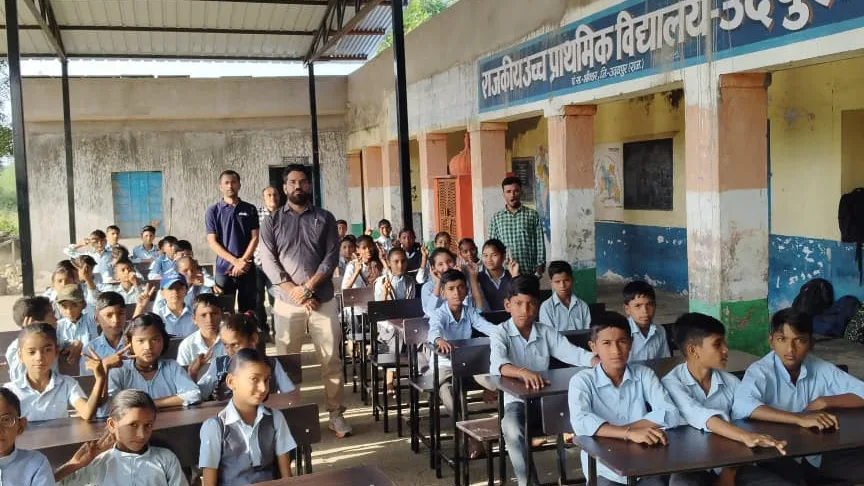
Udaipur Lake City Round Table 206 Donates Desks and Benches to Government School
One PWS Private Limited Supports Community Service Initiative to Create a Better Learning EnvironmentUdaipur:…
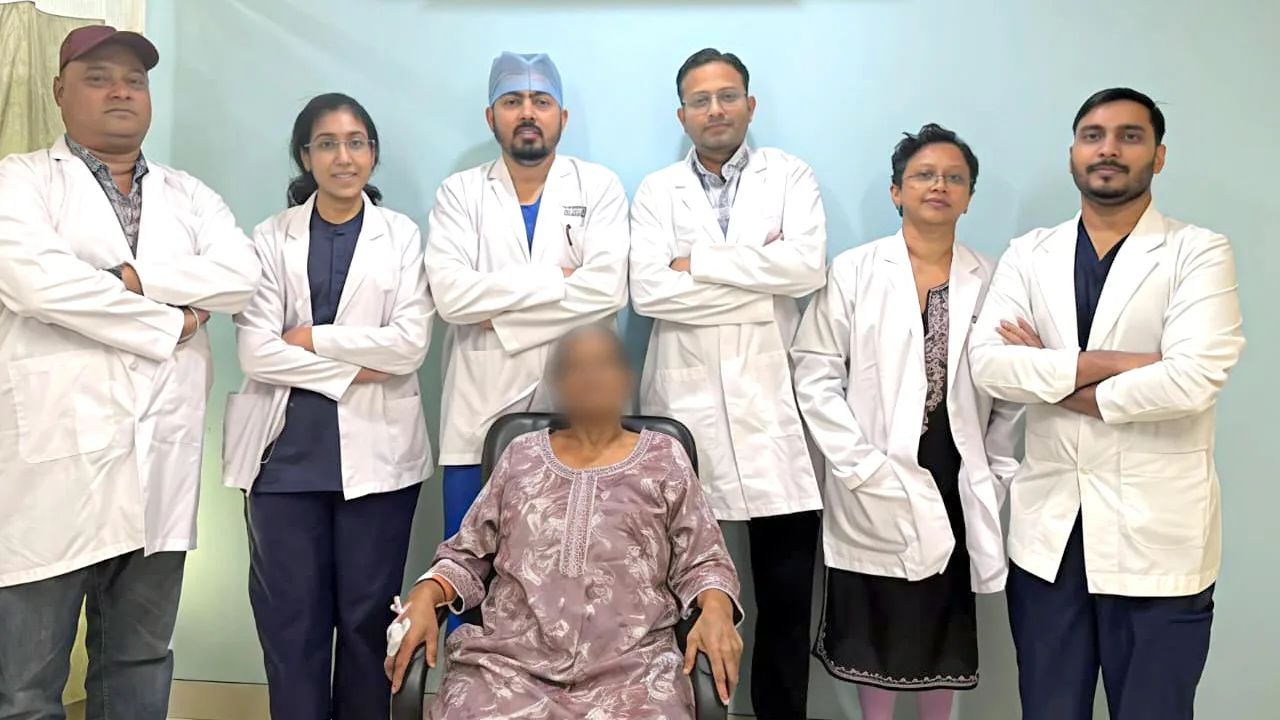
After 30 Years of Medical Struggle, 80-Year-Old Woman Successfully Undergoes Complex Surgery at Geetanjali Hospital
Udaipur: After nearly three decades of health-related difficulties and unsuccessful attempts to identify the…