.png)

Udaipur: The two-day international symposium LASIRE-2026 (Leveraging Artificial Intelligence to Strengthen Innovation & Research Ecosystem), organized at the College of Technology and Engineering (CTAE), Maharana Pratap University of Agriculture and Technology (MPUAT), Udaipur, concluded successfully today. The symposium witnessed active participation from academicians, researchers, industry experts, and students from India and abroad.
On the final day, various technical sessions and expert lectures were conducted, highlighting emerging dimensions of Artificial Intelligence (AI), its applications in research, and its impact across industry and academia. Experts shared insights on AI-driven solutions, data analytics, innovation, and future technological possibilities.
Key Highlights:
-
Amitesh Shukla (USA) emphasized the role of AI agent-based systems in future startups. He explained that modern AI solutions are evolving beyond single models into layered AI agents, enabling more efficient execution of complex tasks across sectors like business, automation, customer service, and decision support. He highlighted that AI agent-based solutions are already operational in several domains and will expand rapidly, creating new opportunities in the startup ecosystem.
-
Dr. Heena Rathore focused on the ethical and moral decision-making aspects of AI, stressing that AI is not merely a technical challenge but also an ethical one—particularly in sensitive fields like healthcare, where AI decisions directly affect human life. She emphasized the importance of fairness, transparency, and accountability in AI systems and advocated responsible use of AI aligned with societal welfare.
-
Dr. N.S. Rathore, the keynote speaker of the day, presented on “Digital Harvest: AI, Machine Learning & IoT in Agriculture – From Future Concepts to Reality.” He discussed how AI, cloud computing, remote sensing, and IoT enable data collection, analysis, and forecasting in agriculture, enhancing decision-making accuracy. He stressed AI’s role in planning and decision support to increase productivity, highlighted Agri 4.0 concepts like smart farming, automation, and real-time data usage, and explored Agri 5.0 prospects, including precision agriculture, vertical farming, and geospatial-based forecasting. He also emphasized machine learning’s role in crop disease detection, yield forecasting, and agricultural management, while blockchain ensures data security and transparency. He concluded, “Future agriculture will not only depend on soil but on data and scientific understanding.”
-
Dr. Manish Unhale (USA) highlighted AI’s transformative role in supply chain management (SCM), particularly for creating sustainable and resilient supply chains. He explained how AI can predict demand, optimize storage locations, and ensure end-to-end visibility, supporting risk management and supply chain stability even during global disruptions. He emphasized that quality data is essential for effective supply chains, and AI tools enhance precision in decision-making.
-
Ketan Bhatt presented on improving AI-based text recognition (HTR) in Devanagari manuscripts using Manuscript Component Separation (MCS). He explained that analyzing different components—background, substrate, and text—separately, rather than using uniform processing methods, significantly improves machine learning accuracy. He highlighted a hybrid approach and domain-specific training, presenting experimental analyses on error rates, precision, and recall, and noted that AI-based models (like YOLO techniques) can achieve high accuracy in page recognition, aiding digital manuscript processing.
Closing Remarks:
Dr. Vikramaditya Dave, symposium coordinator, emphasized AI’s pivotal role in innovation, research, and technological development. He noted that AI enables faster and more effective solutions to complex problems, enhancing efficiency and quality across sectors. He highlighted the importance of fostering collaboration between academia and industry, encouraging youth to develop AI skills and research-oriented mindsets, and stressed responsible AI use for sustainable development.
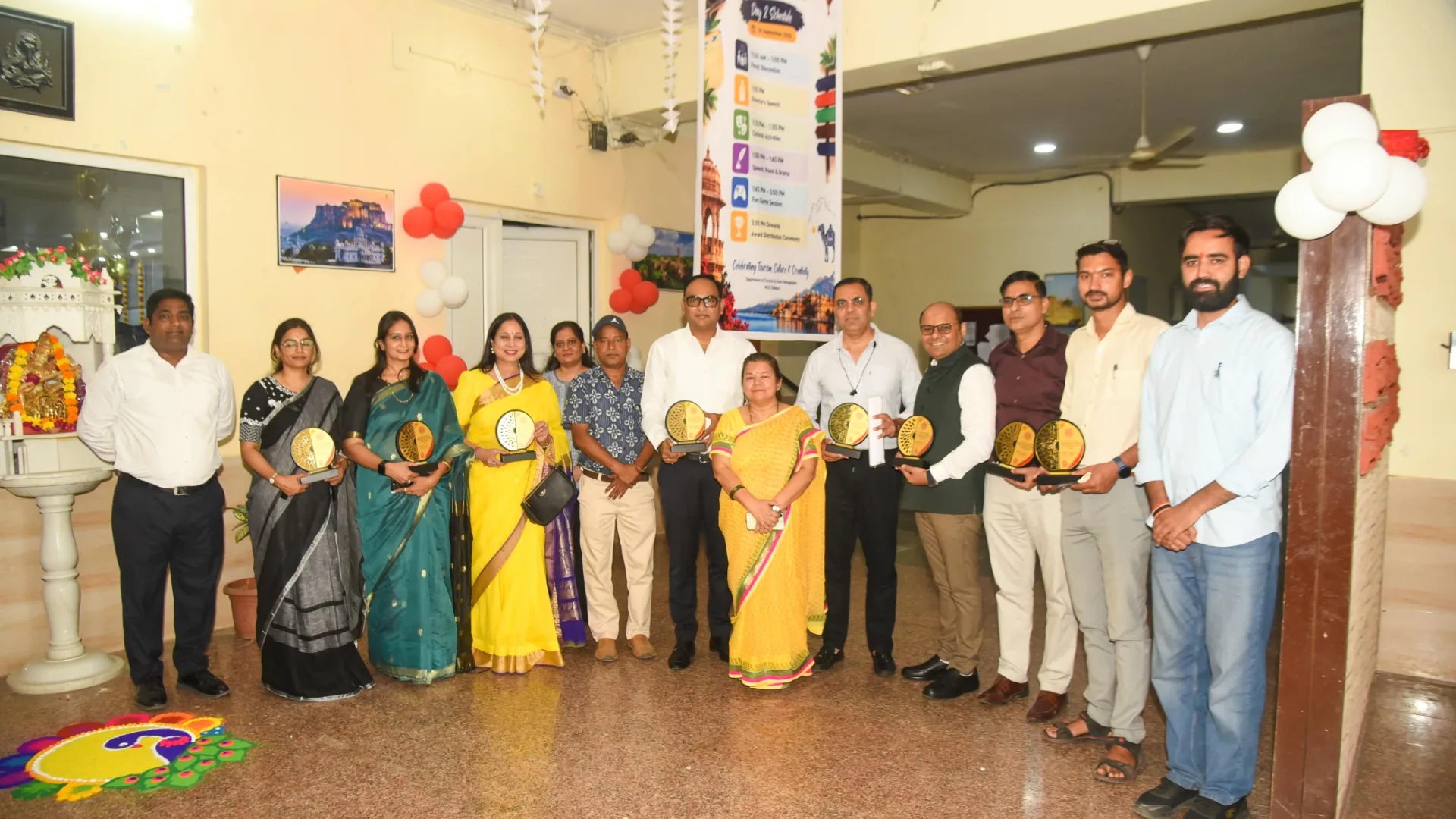
The closing session, chaired by Dr. Sunil Joshi, Dean, CTAE, included prize distribution for the poster presentation competition. Dr. Joshi and Dr. Dave jointly expressed gratitude to all committee members, speakers, and participants who contributed to the symposium’s success. They also specially acknowledged the organizing team—Narottam Soni, Aditya Kachhwaha, Dhruv Saxena, Neha Godha, Kamlesh Tiwari, Omveer Singh, Jigar K. Pathak, Shaifali Goyal, and Gaurav Vasita—for their significant contributions.