
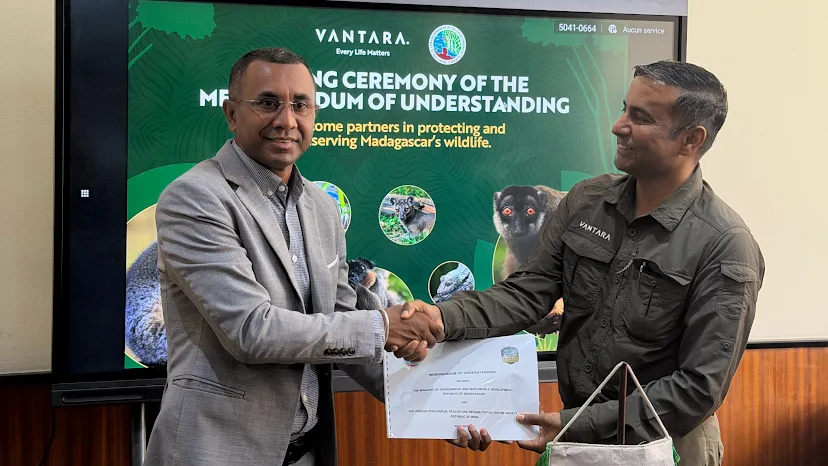
Antananarivo / Jamnagar, 24th November 2026: In a significant
step for some of the most threatened wildlife on Earth, the Ministry of
Environment and Sustainable Development of the Republic of Madagascar (MEDD)
and the Greens Zoological Rescue and Rehabilitation Centre Society (Vantara),
based in Jamnagar, Gujarat, India, today signed a ten-year, non-exclusive
Memorandum of Understanding on wildlife conservation and animal welfare. The
agreement recognises Vantara as a conservation partner of Madagascar and
fulfils a commitment Vantara made to India's CITES Management Authority on 19
August. Under it, the two parties will work together to safely return Malagasy
animals seized abroad to Madagascar, support the rescue, rehabilitation,
veterinary care and, where possible, rewilding of wildlife within Madagascar,
develop a national centre for conservation, research and training, and train
Malagasy wildlife experts for the long term.
H.E. Nolave Luck Aristide Andriatsihala, Minister of
Environment and Sustainable Development, Republic of Madagascar, said:
"Madagascar is a biodiversity hotspot of global importance, and our
wildlife is part of who we are as a nation. These animals belong to the forests
that shaped them. Protecting them takes cooperation across borders, and we are
grateful to the countries and organisations, such as Vantara, who work with us
to safeguard Madagascar's natural heritage."
Rakotondravoninala Valison Kiady, Director General of
Environmental Governance, MEDD, said: "Vantara brings world-class
expertise in animal rescue, veterinary care and welfare, and we look forward to
working together to turn this commitment into concrete actions, from immediate
deliverables to long-term, results-oriented programmes, all guided by science,
regulations and international best practice."
Vivaan Karani, Chief Executive Officer, Vantara, said:
“Madagascar is home to some of the world’s most extraordinary and unique
wildlife, and protecting these species in their natural habitats is central to
our ten-year conservation strategy. Our priority is to strengthen the people
and institutions working to conserve wildlife in its country of origin. We
thank the Government of Madagascar for this partnership and look forward to
supporting its long-term conservation priorities, with every decision resting
firmly with Madagascar.”
The agreement arrives at a critical moment. According to the
IUCN Red List of Threatened Species, 90% of lemur species, all found only in
Madagascar, are threatened with extinction and almost a third are Critically
Endangered. The Turtle Survival Alliance estimates that the wild population of
the radiated tortoise fell by more than 47% between the late 1990s and 2013,
and the country lost around 29% of its tree cover between 2001 and 2023.
Madagascar's environment minister has described illegal
wildlife trade as the second leading cause of biodiversity decline after
habitat loss, and between January and April 2026 alone, rescuers in Madagascar
received more than 1,000 tortoises from six confiscation cases. For animals
seized abroad, the ordeal rarely ends at interception. When Thai authorities
intercepted 48 lemurs and more than 1,000 tortoises in 2024, 131 tortoises had
already died in transit, and others did not survive the weeks that followed.
Thailand cared for the surviving animals and supported their return, but no
dedicated funding was available, and complex international permit procedures
delayed the flights back to Madagascar twice.
This is where Vantara comes in. Animals who survive
trafficking are often weakened, and a poorly managed journey can cost lives. At
Madagascar's request, Vantara's teams can support every stage of a return, from
health checks and disease screening to transport, quarantine and care on
arrival. Vantara will also share scientific expertise, including support for
field research and genetic profiling, to help Madagascar decide, in line with
IUCN guidelines, which animals go back to the wild, and where. Every decision
will rest solely with the Government of Madagascar, advised by the country's
CITES Scientific Authority.
Vantara may support the construction and establishment of
Madagascar's National Wildlife Rescue and Rehabilitation Centre, a national hub
for conservation, research and training that will remain the property of the
Republic of Madagascar and operate under MEDD's authority, on land provided by
the Government of Madagascar. Through training, internships, specialist
exchanges and applied research, the partnership will help Malagasy teams care
for, rehabilitate and, where conditions allow, return rescued animals to the
wild.
The partnership reflects Vantara's commitment to in situ
conservation: protecting animals in their home range, and strengthening ex situ
efforts such as rescue and rehabilitation within the countries where those
animals belong, so that this work contributes directly to the survival of
species in the wild. In Madagascar, the aim is to build the expertise,
facilities and trained people in the country, for animals who belong there.