

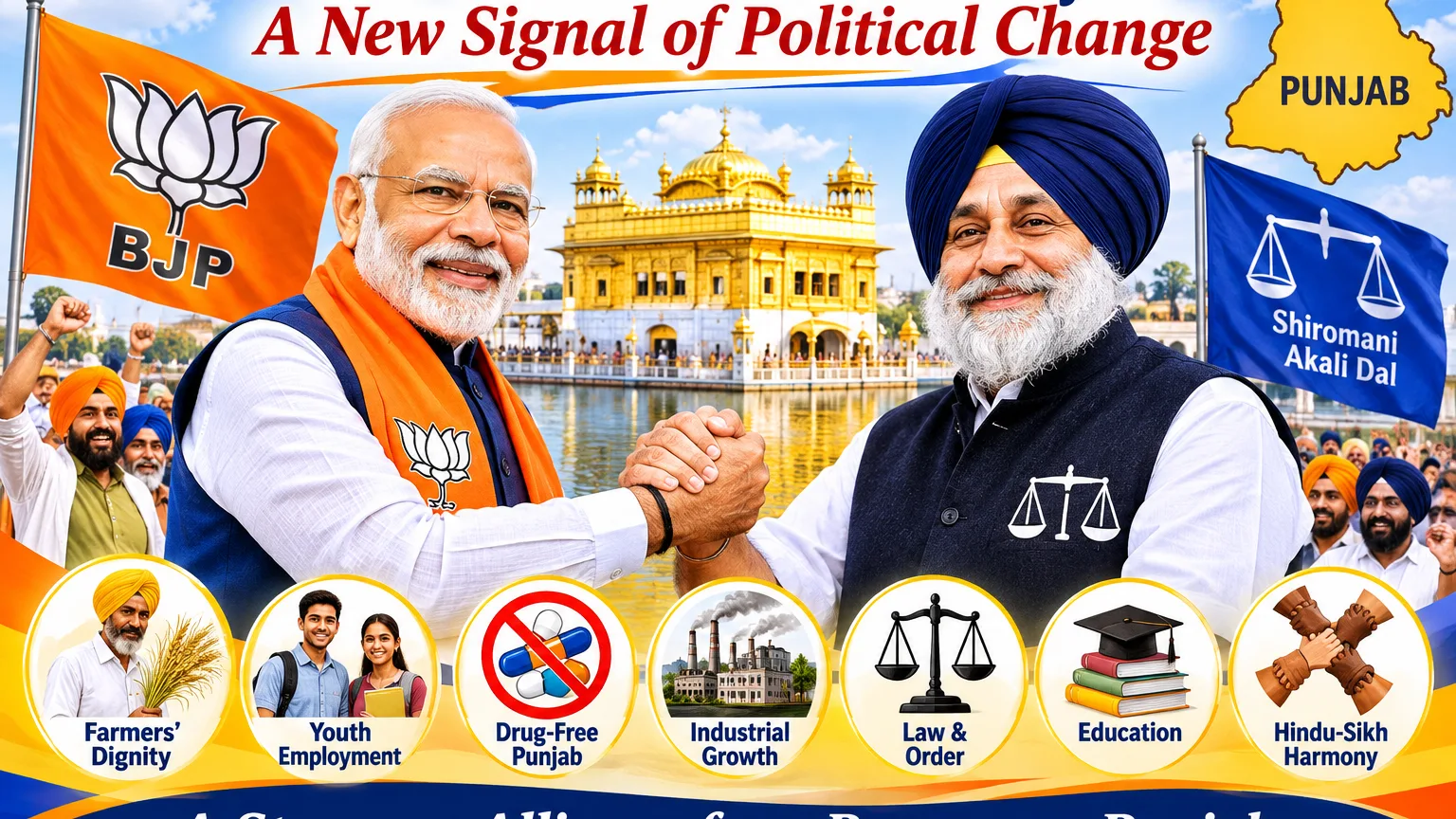
The coming together of the Bharatiya Janata Party (BJP) and the Shiromani Akali Dal (SAD) in Punjab after six years is not merely a revival of an alliance between two political parties; it signals a significant shift in the state’s changing political equations. Announced on the occasion of the Prakash Parv of Guru Nanak Dev Ji, the alliance could emerge as a strong challenge to the Aam Aadmi Party (AAP) government in the 2027 Punjab Assembly elections. The two parties’ long political association, their experience of governing together and their complementary social bases give this alliance considerable significance. Although the announcement of an electoral alliance can never guarantee a change of government, it is certainly clear that the political contest in Punjab has now become more interesting, competitive and potentially triangular. The relationship between the BJP and the Akali Dal is older than the formal formation of the National Democratic Alliance. During the era of Atal Bihari Vajpayee, Lal Krishna Advani and Parkash Singh Badal, the two parties established a political partnership that remained a successful model in Punjab for a long time. The Akali Dal’s influence among the rural and Sikh population and the BJP’s support base among urban Hindus, traders and the middle class complemented each other. Because of this social and political combination, the two parties succeeded in forming governments in Punjab on several occasions.
However, in 2020, amid the widespread farmers’ movement against the three agricultural laws, this relationship broke down. The Akali Dal distanced itself from the BJP, and Harsimrat Kaur Badal resigned from the Union Cabinet. At that time, the decision was taken under pressure from farmers’ sentiments and the political circumstances prevailing in Punjab. However, subsequent elections also demonstrated that both parties had to pay a political price for their separation. In the 2022 Punjab Assembly elections, the Aam Aadmi Party won 92 of the 117 seats and secured power in the state with an impressive mandate. In contrast, the Akali Dal was reduced to just three seats and the BJP to two. The two parties also contested the 2024 Lok Sabha elections separately. The Congress won seven seats, the AAP three and the Akali Dal one, while the BJP failed to win a single seat. However, the BJP secured around 18.6 per cent of the vote, while the Akali Dal received approximately 13.5 per cent. This clearly indicated that both parties still possess significant individual political support, but when they contest separately, their votes do not effectively translate into seats.
Now, after six years, both parties appear to have learnt from their experience and decided to come together again. This can be described as a political course correction as well as a practical recognition of changed circumstances. The alliance is naturally likely to have its greatest impact on the Aam Aadmi Party. In 2022, the AAP benefited significantly from a fragmented opposition. The Congress, Akali Dal and BJP contested separately, and the anti-incumbency vote could not consolidate behind a single alternative. The situation has now changed. If the BJP’s urban and middle-class support and the Akali Dal’s rural organisation and traditional grassroots network succeed in transferring votes effectively to each other, the challenge for the AAP will certainly increase. This is why the alliance can be viewed as the beginning of a serious political challenge to the present Punjab government.
For the BJP, the alliance is strategically important as well. Although the party has increased its vote share in Punjab, it has faced difficulties in converting that support into seats. Contesting elections independently has made it challenging for the BJP to reach a broader rural and Sikh social base. An alliance with the Akali Dal could give the BJP wider access to Punjab’s local social and political structure. For the Akali Dal, on the other hand, the alliance provides an opportunity for political revival. Once a decisive force in Punjab politics, the Akali Dal has witnessed a substantial decline in its political influence in recent years. Returning to an alliance with the BJP is therefore not merely an attempt to return to power; it is also an opportunity to rebuild confidence among its organisation and cadre.
Yet, the biggest challenge before this alliance is credibility. Six years ago, the two parties separated over the farm laws issue. The revival of the relationship naturally raises questions. The Akali Dal will have to explain to its supporters why circumstances have changed and what the basis of its renewed association with the BJP is today. The BJP, too, will need to develop a new and credible language of dialogue and engagement with farmers. In a democracy, political parties have every right to form alliances, but they also have a responsibility to respect public trust. Coming together despite ideological differences is not necessarily opportunism; the problem arises when political parties fail to provide a convincing explanation for the gap between their earlier position and their present decision.
The political experiences of West Bengal and Delhi provide a broader context for understanding the BJP’s strategy. In West Bengal, the BJP gradually established itself among political forces that had long dominated the state, while in Delhi it challenged the Aam Aadmi Party’s strong political dominance and succeeded in capturing power. Punjab is different, but the BJP is now also exploring the possibility of expanding its political prospects here through organisation, alliance-building and social equations. The Akali Dal’s support can provide a local foundation for this strategy. However, the people of Punjab will not be influenced merely by political arithmetic. Farmers, youth, employment, drug abuse, industry, law and order, education and the state’s economic condition will form the real basis of the election. Most importantly, the BJP–Akali alliance will have to move beyond simply adding vote percentages on paper and actually unite workers and voters on the ground. After six years of separation, rebuilding trust between the cadres of the two parties will not be easy. An agreement among the leadership alone will not be sufficient; political cooperation and mutual confidence must reach the booth level. If BJP workers work wholeheartedly for Akali candidates and Akali workers work with equal commitment for BJP candidates, only then will the real strength of the alliance become visible.
The political contest in Punjab is no longer simply a battle between the government and the opposition. It is likely to become a triangular contest involving an assessment of the AAP government’s performance, the Congress’s attempt to regain lost ground, and the new political possibilities created by the BJP–Akali alliance. The alliance is certainly a warning bell for the AAP, but it would also be premature to regard it as a guarantee of a change in government. Ultimately, the electoral verdict will depend on performance and public trust. If the AAP government succeeds in retaining public confidence, the impact of the alliance may remain limited. But if anti-incumbency sentiment becomes strong, the BJP–Akali alliance could provide that sentiment with an organised political alternative.
The greatest test of this alliance will be whether the BJP and the Akali Dal have come together merely to regain power or whether they also possess a shared vision for Punjab’s future. If farmers’ dignity, employment for the youth, a drug-free Punjab, industrial development, law and order, and Hindu-Sikh harmony become the core of their common agenda, the alliance could become more than an electoral arrangement—it could emerge as a new political axis in Punjab. The separation of 2020, the defeat of 2022 and the separate electoral contest of 2024 have taught both parties that political differences may exist, but completely abandoning their shared political ground serves neither side. The year 2027 will reveal whether this reunion is merely a political compulsion or truly signals a new beginning and a hopeful future for Punjab’s politics. The leaders have joined hands, but the people of Punjab will decide whether that alliance succeeds.