
The true measure of a nation’s progress cannot be determined merely by its economic growth rate, Gross Domestic Product (GDP), industrial expansion or global economic ranking. Development acquires real meaning only when its benefits reach the last person in society, the extent of poverty diminishes, and ordinary citizens experience greater security, dignity and prosperity. Its ultimate purpose is to eradicate the stigma of poverty and ensure equal access to economic opportunities for all. From this perspective, the remarkable decline in poverty and deprivation in India represents a historic achievement and a promising sign of the emergence of a new India. The latest World Bank report, which recognises India’s progress among the most significant reductions in poverty at the global level, lends further importance to this accomplishment. This is not merely a transformation reflected in economic statistics; it is a story of positive change in the lives of millions of people. The sustained efforts towards poverty alleviation over the past decade under the leadership of Prime Minister Narendra Modi have produced significant results, offering a hopeful glimpse of a more inclusive and prosperous future.
According to the World Bank report, between 2011 and 2023, India's extreme poverty rate declined from 27.1 per cent to 2.6 per cent. During the same period, the proportion of the population living below the international poverty threshold of $4.20 per day fell from 57.7 per cent to 16.1 per cent. This means that approximately 496 million people moved out of poverty. The report also projects that this proportion could decline further to 12.1 per cent by 2028. These figures represent a significant transformation in India's economic and social journey. What makes this achievement particularly noteworthy is that India has succeeded in reducing poverty despite its enormous population, extensive social diversity and the unprecedented challenges posed by the global COVID-19 pandemic. This progress reflects the impact of the Modi government's far-reaching welfare initiatives and its commitment to poverty eradication.
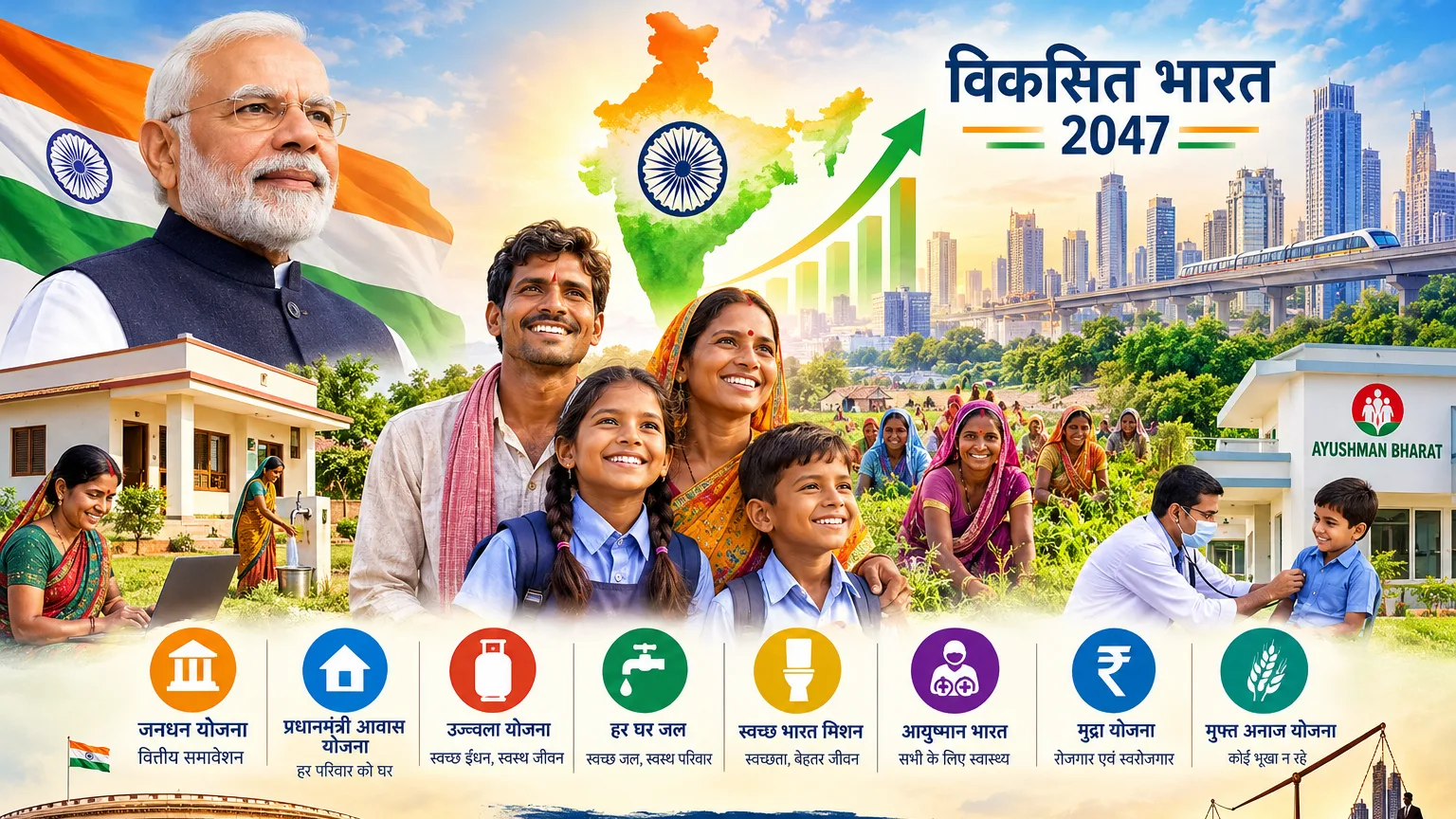
Behind this transformation lies not merely economic growth but also a policy framework that seeks to connect development with public welfare. Under Prime Minister Modi's leadership, initiatives such as the Pradhan Mantri Jan Dhan Yojana, Pradhan Mantri Awas Yojana, Ujjwala Yojana, Swachh Bharat Mission, Har Ghar Jal, Ayushman Bharat, Mudra Yojana and free food-grain distribution have brought substantial changes to the lives of economically weaker families. The distinctive feature of these initiatives is that they have approached poverty not simply as a shortage of income, but as a multidimensional challenge linked to housing, healthcare, education, sanitation, drinking water, electricity, food security and financial inclusion. By addressing these fundamental needs, the government has sought to improve the overall quality of life of disadvantaged communities and create the foundations for a more dignified existence.
For a poor family, owning a permanent house is not merely the fulfilment of a housing requirement; it provides an asset, a sense of security and social dignity. Access to electricity, sanitation facilities and tap water brings fundamental improvements in living conditions. Jan Dhan bank accounts and Aadhaar-based systems have strengthened financial inclusion and provided citizens with a recognised identity within the formal system. Ayushman Bharat has created an important safety net for economically vulnerable families, particularly during medical emergencies. The World Bank has identified increased consumption, expanding employment opportunities, particularly the rising participation of women in the workforce, and social welfare transfers, including food subsidies, as significant factors contributing to poverty reduction. The addition of approximately 134 million people to the workforce between 2017 and 2023 is another noteworthy development. The growing participation of rural women deserves particular recognition. Their increasing economic engagement not only raises household incomes but also strengthens financial independence, social confidence and decision-making power within families. The substantial decline in rural poverty has also contributed to narrowing the economic divide between rural and urban India.
Another important indicator is the Gini Index, which measures inequality in the distribution of income or consumption. According to the available figures, India's consumption-based Gini Index has reached 23, indicating a relatively low level of consumption inequality. This places India in a comparatively favourable position when measured against countries such as the United States and South Africa. However, it is important to recognise that a consumption-based Gini Index does not provide a complete picture of inequalities in wealth, income and economic opportunities across society. Therefore, the reduction in poverty should not be interpreted as the complete achievement of economic equality. This is precisely where a critical assessment of India's development journey becomes necessary.
While millions of people are moving out of poverty, the concentration of wealth and economic resources remains a serious challenge. The gap between affluent sections of society and ordinary working people is still visible in access to quality education, healthcare, employment and opportunities for a better life. The shortage of secure and productive employment, the vulnerability of workers in the unorganised sector, unemployment among young people, the limited incomes of families dependent on agriculture and unequal remuneration for women are pressing concerns. Without addressing these challenges, the vision of an equitable and inclusive society will remain incomplete. A decline in poverty and a reduction in the gap between the rich and the poor are two entirely different objectives. The former is undoubtedly a source of encouragement, but the latter demands sustained attention and determined policy intervention. India now needs a development strategy in which the benefits of economic progress are not confined to a handful of sectors, social groups or industries. Quality education, affordable healthcare, skill development, support for small enterprises, agricultural modernisation, social security for workers and dignified employment opportunities for women can play a decisive role in achieving this objective. A fair balance in the taxation system, greater investment in rural and underdeveloped regions, and transparency in the implementation of welfare schemes are equally essential. The real objective of development must be to create equality of opportunity rather than merely achieve impressive economic statistics.
India is moving rapidly towards its ambition of becoming the world's third-largest economy. In this context, the significant reduction in poverty assumes special importance. The vision of a Developed India by 2047 will acquire genuine meaning only when economic strength is accompanied by social justice, human dignity and equal opportunities. The dream of a poverty-free India cannot be realised through government schemes alone; it requires a coordinated approach encompassing employment generation, entrepreneurship, education, social participation and a just economic framework. The latest World Bank report presents an encouraging picture of India's steady movement towards freedom from poverty and the growing prosperity of millions of lives. It is as though the lamps of development have begun to illuminate the nation during the festival of Diwali. This is not merely the brightness of statistical achievements; it is the light of hope, self-confidence and dignity entering the lives of millions of families emerging from the darkness of deprivation and moving towards prosperity. Indeed, this Diwali, the lamps of celebration seem to reflect not only the progress of a new India but also the renewed optimism and improved living conditions of its poorest citizens.
Undoubtedly, India's success on the poverty front is a strong foundation for building a New India, a Prosperous India and a Self-Reliant India. Bringing millions of people out of poverty stands among the significant achievements of Prime Minister Narendra Modi's tenure. However, the next phase of this achievement must focus on bridging the widening economic divides and ensuring that the light of development reaches every section of society. The true identity of a developed nation lies not merely in its economic prosperity but in its ability to ensure that no individual is compelled to live in hunger, deprivation, illiteracy or helplessness. India in 2047 will be genuinely developed and prosperous only when the benefits of progress reach those standing at the very last rung of the social and economic ladder, and when social harmony, equality and human dignity become as defining a feature of the nation as its economic strength. This is the dream of a New India, and it is also the ultimate test of its development journey.