

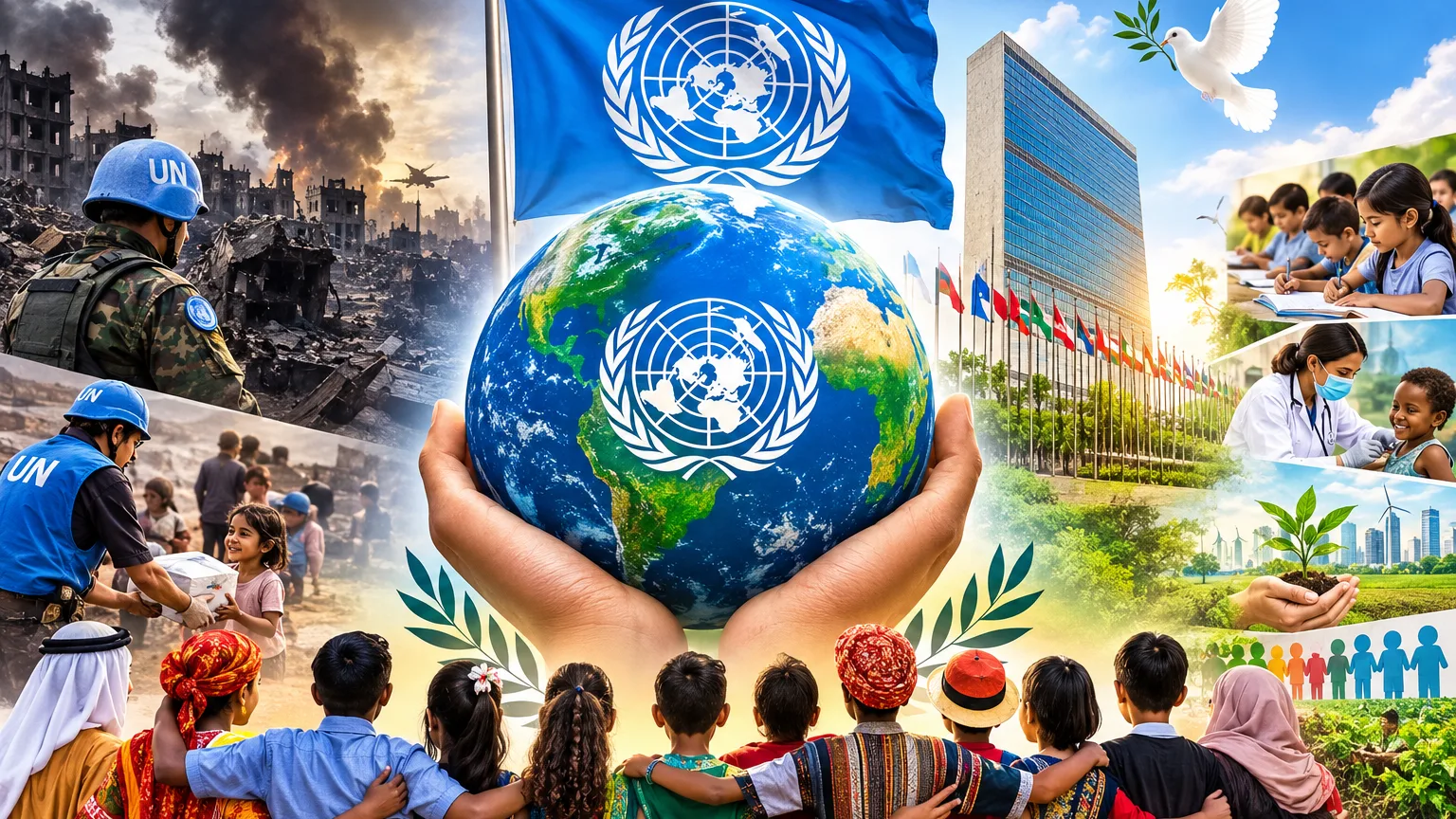
United Nations Day is not merely a celebration of the establishment of an international organisation; it is an occasion to reaffirm the ideals of world peace, human rights, justice, equality and cooperation among nations—ideals that inspired the creation of the United Nations in the aftermath of the devastation of the Second World War. When the UN Charter came into force on 24 October 1945, the world placed its hopes in a new international order in which dialogue would prevail over war, cooperation over confrontation, and justice over the brute force of power. Today, however, as the world grapples with multiple wars, terrorism, geopolitical rivalries and humanitarian crises, serious questions are being raised about the role, impartiality and effectiveness of the United Nations. When an organisation expected to uphold international justice, itself comes under a cloud of suspicion, a process of introspection becomes imperative. It would be unfair to overlook the achievements of the United Nations. It has provided a common platform for international dialogue, established global standards of human dignity through the Universal Declaration of Human Rights, and sought to restore stability in several countries through peacekeeping operations. Its various agencies have made significant contributions to global health, child welfare, education, refugee assistance and sustainable development. Yet the fundamental question remains: has the United Nations succeeded in fulfilling its most critical responsibilities—preventing wars, effectively curbing terrorism and ensuring equal treatment for all nations? The experience of recent years offers no reassuring answer.
The greatest weakness of the United Nations is evident in the structure of its Security Council. The veto power enjoyed by the United States, Russia, China, France and the United Kingdom often becomes an instrument for safeguarding their national interests rather than advancing global peace. Whenever decisive action on a war or humanitarian catastrophe is blocked by geopolitical rivalries, the declarations and appeals of the United Nations begin to lose their moral authority. Conflicts such as those in Gaza, Ukraine and Syria have sharpened the question of whether an organisation entrusted with maintaining international peace is genuinely capable of playing a decisive role. The irony is that while the world has changed dramatically, the UN’s decision-making framework remains largely shackled to the same old balance of power.
A recent controversy concerning Dawood Ibrahim and his criminal syndicate, D-Company, has further raised questions about the credibility of the United Nations. A report by Ben Saul, the UN Special Rapporteur on the promotion and protection of human rights and fundamental freedoms while countering terrorism, described D-Company as an “India-based” criminal syndicate. On 21 October 2026, India strongly objected to this description before the Third Committee of the UN General Assembly, calling it factually incorrect and damaging to the organisation’s credibility. Indian representative Raghu Puri referred to Dawood Ibrahim’s history of involvement in terrorist activities and the relevant facts recorded in the UN sanctions list. He emphasised that Dawood is a wanted fugitive in India and, according to India, is residing in Pakistan.
This controversy is serious because factual accuracy and impartiality must be paramount in matters as sensitive as terrorism. Incorrect or incomplete information about the geographical origins or base of a terrorist organisation is not merely an error in a report; it raises questions about the credibility of international counterterrorism efforts. While a mistake in one report cannot justify dismissing the entire work of the United Nations, it is essential to ensure that such errors are investigated, corrected and accompanied by appropriate accountability. The independence of Special Rapporteurs is important, but independence cannot mean freedom from factual scrutiny or responsibility.
The United Nations must also adopt a balanced approach to human rights. Human rights are not confined by national borders, but conclusions drawn against any country in their name must be based on credible evidence and a careful assessment of the circumstances. The rights of civilians affected by terrorism must receive the same serious consideration as the rights of individuals who may be wronged during counterterrorism operations. The human rights of terrorism victims are just as important as those of innocent people affected by measures taken to combat terrorism. If the international community appears to apply different standards to those who sponsor terrorism, those responsible for violence and those who suffer its consequences, doubts about its impartiality are bound to arise.
Another major challenge confronting the United Nations is the unequal representation of nations and regions. Despite the growing global importance of countries such as India and the increasing influence of Africa and Latin America, comprehensive reform of permanent membership and the veto system in the Security Council remains elusive. Without a structure that reflects the contemporary political, economic and demographic realities of the world, it will be difficult to make the United Nations more democratic, representative and legitimate. A common strategy against terrorism, effective mechanisms for securing ceasefires, uninterrupted access to humanitarian assistance and the equal enforcement of international law must also become priorities. The real meaning of introspection on United Nations Day lies not in merely celebrating the organisation’s achievements, but in acknowledging its shortcomings and resolving to correct them. The UN must ensure greater transparency in decision-making, factual accuracy in its reports, accountability among its officials and impartiality towards every nation. Concrete initiatives are needed to curb the misuse of veto power, expand the Security Council and eliminate double standards in the fight against terrorism.
At a time when the world is passing through an era of war, terrorism, violence, humanitarian emergencies and growing distrust among nations, the relevance and responsibility of United Nations Day have become greater than ever. This day is not simply a commemoration of the founding of an international organisation; it is an opportunity to renew the global commitment to peace, coexistence, human dignity and international cooperation. Through its impartiality, credibility and effectiveness, the United Nations must demonstrate that it serves not the interests of powerful nations, but the cause of justice and security for all humanity. Its fundamental responsibility is to prevent wars, curb terrorism and pave the way for peace. The purpose of the United Nations is not to govern the world, but to help protect it from war, injustice and destruction. Its prestige will be determined not by the declarations it issues or the principles it proclaims, but by the impartial and effective action it takes when the world faces a crisis. The message of 24 October will acquire genuine significance only when the organisation returns to the spirit of its founding principles and becomes a trusted forum for equal justice for all nations—powerful or vulnerable, large or small. The United Nations must preserve not merely its existence, but also its relevance. To achieve this, freedom from bias, institutional accountability and far-reaching structural reforms are no longer optional; they have become an absolute necessity.