.png)
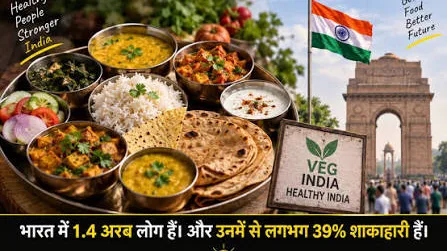
Amid rising diseases, stressful lifestyles and mounting environmental crises, humanity is increasingly being compelled to rethink its food choices. Across many parts of the world, there is growing recognition that changes in our diet are essential for improving the quality of life and maintaining good health. In this context, vegetarianism is emerging not merely as a way of eating, but as a broader philosophy of life encompassing compassion, non-violence, health, environmental protection and balance. World Vegetarian Day, observed every year on October 1, provides an opportunity to create greater awareness about this way of life. The observance began in 1977 at the initiative of the North American Vegetarian Society and received the support of the International Vegetarian Union in 1978. Its purpose is to promote awareness of the health, environmental, ethical and humanitarian dimensions of vegetarianism. Today, vegetarianism needs to be understood not as a narrow religious or dietary identity, but as a conscious approach to a healthy and balanced lifestyle.
Food nourishes not only the human body; it also influences the mind, thoughts and behaviour. As is the food, so is the disposition; and as is the disposition, so is life—this has long been an important idea in Indian thought. From this perspective, vegetarianism can become a means of achieving balance between body and mind. Fruits, vegetables, pulses, grains, nuts, seeds and other plant-based foods, when consumed in appropriate combinations, can form an important part of a healthy diet. At the same time, nutritional balance remains essential in every dietary pattern, and food choices should be guided by an individual's age, health condition and nutritional requirements. Mahatma Gandhi believed that food was not merely a matter of taste but also a matter of self-restraint. He regarded control over taste and appetite as an important part of the discipline of life. Indeed, the purpose of food should not simply be to satisfy the palate, but to nourish the body, preserve health and cultivate moderation. At a time when taste, consumerism and market-driven food culture are rapidly influencing our eating habits, vegetarianism offers an opportunity to return to simplicity, restraint and conscious choice.
Vegetarianism is connected not only with health but also with compassion and non-violence. The Indian civilizational ethos has for centuries been guided by the spirit of “Ahimsa Paramo Dharma” — non-violence is the highest ethical principle. Lord Mahavira recognised the fundamental equality of all living beings and placed non-violence at the very heart of spiritual life. Gautama Buddha, Mahatma Gandhi and numerous saints and thinkers likewise regarded compassion and non-violence as essential human values. Jain philosophy, in particular, considers friendship, compassion and sensitivity towards every living being to be fundamental to a meaningful life. Thus, vegetarianism is not merely a change in what appears on our plate; it represents a change in our way of looking at life. It encourages us to ask whether the food we consume comes at the cost of another living being.
An equally important dimension of vegetarianism is its relationship with the environment. Livestock farming and industrial meat production require substantial amounts of land, water, feed and energy. Livestock-related activities are also associated with greenhouse-gas emissions, intensive water use and increasing pressure on land resources. At a time when the world is confronting climate change, water scarcity, land degradation and the loss of biodiversity, it has become essential to rethink sustainable and balanced food systems. From this perspective, the growing interest in plant-based foods has become an important part of the environmental conversation. Vegetarianism, however, means more than simply giving up meat. It means becoming conscious of what we eat, why we eat it and what consequences our choices have.
Across the world, interest in plant-based diets has been growing. Societies that once associated meat consumption with modernity and prosperity are increasingly reconsidering food choices in the light of health, environmental sustainability and animal welfare. Numerous scientists, writers, philosophers and social thinkers have advocated vegetarianism or reflected deeply on compassion and dietary choices. Figures such as Leonardo da Vinci, Leo Tolstoy, George Bernard Shaw and Mahatma Gandhi have all been associated, in different ways, with vegetarianism and the ethical questions surrounding food. This changing perspective demonstrates that humanity's understanding of food is not static. Experience, scientific knowledge and changing circumstances continually shape the way societies eat and think about food.
For India, this subject is particularly significant because vegetarianism has deep roots in its agricultural traditions, spiritual heritage and philosophy of non-violence. Pulses, grains, vegetables, fruits, milk, curd, ghee, nuts and a wide variety of plant-based foods have been integral to Indian diets for centuries. Ayurveda, too, has emphasised the importance of aligning food with the body, individual constitution and lifestyle. Therefore, vegetarianism is not a new fashion for India; rather, it offers an opportunity to renew an ancient way of life in harmony with modern scientific understanding. A matter of particular concern is the emergence among the younger generation of eating habits driven by fashion, convenience and taste, sometimes at the expense of health and sensitivity. Vegetarianism should not be presented to young people merely as a tradition or religious obligation. It needs to be explained through the broader perspectives of science, nutrition, health, environmental responsibility and human values. If young people understand that their plate is connected not only with their personal health but also with the health of the planet and their attitude towards other forms of life, vegetarianism can become not a burden but a conscious and meaningful choice.
Jainism represents one of the oldest and deepest philosophical foundations of this consciousness. The Jain principle of “Live and let live” is not merely a religious teaching; it reflects an exceptionally sensitive approach to life itself. At a time when the world is struggling with violence, wars, stress and intolerance, it is important to connect the principle of non-violence in our food choices with our conduct and relationships in every sphere of life. Vegetarianism can also contribute to a broader conversation about economic and food-system balance. In an agriculture-based economy, growing demand for plant-based foods can support local farming, horticulture, pulses, grains, fruits, vegetables and other nutritious foods. It can also contribute to discussions on food security, water conservation and sustainable agriculture. However, these challenges cannot be addressed through vegetarianism alone. Scientific agricultural practices, efficient food distribution, responsible water management and balanced public policies are equally necessary.
As India moves towards the vision of Viksit Bharat 2047, development cannot be measured merely in terms of economic prosperity. Healthy citizens, harmonious families, a clean environment, a compassionate society and an ethical way of life must also be regarded as important indicators of progress. Vegetarianism, as a way of life, has the potential to connect these diverse dimensions of human well-being. Therefore, World Vegetarian Day should not remain merely a one-day observance. It should become an occasion for introspection about our food choices and our way of life.
The need today is not to impose any particular dietary practice on anyone, but to create a positive environment of awareness in which individuals can make informed food choices based on health, nutrition, environmental responsibility, compassion and ethical values. Education about balanced nutrition in schools, healthy eating habits within families, greater awareness among young people about nutrition and environmental sustainability, and a stronger spirit of compassion towards living beings can together transform vegetarianism into a broader social consciousness. World Vegetarian Day reminds us that our plate is not merely a matter of personal preference. It is connected with our health, our planet and our capacity for compassion. When compassion enters our food choices, it can find expression in our behaviour as well. When moderation becomes part of our lives, our responsibility towards natural resources grows. And when non-violence extends from our food to our conduct, the possibilities for peace and harmony in society become stronger. Vegetarianism, therefore, is not simply about changing what we eat. It is a step towards making our worldview more compassionate, balanced, responsible and humane. That is the deeper message of World Vegetarian Day—and perhaps one of the important needs of our time.