
Diwali is not merely a festival celebrating the victory of light over darkness; it is an opportunity to awaken the dormant consciousness within us, to give direction to a life that may have lost its way, and to reassess our values at the present stage of civilisation. Today, India is moving rapidly on the path of becoming a developed, prosperous, capable and self-reliant nation. The world is looking at India with renewed confidence because of its economic strength, technological capabilities, cultural heritage and spiritual vision. At such a time, the lamp of Diwali should not remain confined to the doorstep of our homes; it must also illuminate the vast sky of our national consciousness. A profound question confronts us: when the number of lamps around us is increasing, why is the inner light of human beings growing dimmer? Homes are glowing, markets are illuminated, cities are shining with electric lights and technology is filling life with conveniences. Yet stress, insecurity, violence, selfishness, intolerance and attachment continue to deepen within the human mind. Is it possible that we have lit countless lamps outside but forgotten to place a wick within ourselves?
The roots of terrorism, violence, war, hatred and hostility do not lie merely in machines or weapons; they originate in distorted human consciousness. Therefore, a lasting solution to terrorism cannot come only through security arrangements. Humanity must resolve to abandon unnecessary violence. As long as the fire of revenge continues to burn within the human heart, the lamp of peace cannot shine completely across the world. Non-violence is not merely a principle of Jain philosophy; it is a necessity for the future of human civilisation. There is a beautiful spiritual anecdote. Darkness once complained to Brahma that the Sun was constantly pursuing it and wanted to destroy it. The Sun replied, “I don't even know what darkness is, let alone having any desire to destroy it. First, bring darkness before me.” When darkness was asked to appear before the Sun, it replied, “How can I come before him? The moment I stand before him; my very existence will disappear.”
This is precisely the relationship between spiritual wisdom and ignorance. Where the Sun of knowledge rises, the darkness of ignorance cannot survive. Where the lamp of compassion burns, the shadows of violence cannot remain. Where the flame of self-restraint is kindled, the dominion of attachment and delusion gradually begins to collapse. That is why the true significance of Diwali lies not merely in cleaning our homes but in cleansing our inner selves. For months, we remove dust from every corner of our homes, organise old belongings, decorate our walls and give our houses a new appearance. But do we ever sweep away the dust of jealousy accumulated in the corners of our minds? Do we cleanse the soot of anger? Do we remove the webs of ego? Do we throw away the old baggage of greed and attachment? If, this Diwali, we are able to undertake such an inner cleansing, the festival will become the greatest celebration of our lives.
Acharya Shri Mahapragya, the great Jain philosopher and saint, regarded introspection as a pathway to inner illumination. His message was clear: our habit of looking outward has become very strong, while the discipline of looking within has weakened considerably. Today, human beings possess countless means to see the world, but hardly any time to see themselves. The mobile screen is glowing, but the screen of the mind is becoming blurred. The reservoir of information is expanding, but the lamp of self-awareness is gradually becoming faint. This is perhaps one of the greatest paradoxes of our times: we are preparing to reach the Moon, yet we hesitate to enter the dark corners within ourselves.
A New India will not be created merely through towering buildings, a rapidly growing economy, advanced technology and world-class infrastructure. The true identity of a developed India will emerge from the evolved consciousness of its citizens. Prosperity becomes meaningful only when compassion remains alive. Power becomes constructive only when accompanied by restraint. Science becomes beneficial only when guided by wisdom. And development becomes complete only when both human beings and nature remain at its centre. India's timeless cultural tradition gave humanity this profound message centuries ago: “Tamaso Ma Jyotirgamaya” — Lead me from darkness to light. To move from darkness to light, from ignorance to knowledge, from indiscipline to self-restraint, and from selfishness to selflessness—that is the enduring spirit of Indian civilisation.
As India moves towards establishing itself as a global leader and a guiding force for humanity, its greatest strength will not be merely its economy or technological prowess. Its greatest capital will be its timeless civilisational wisdom and humane worldview. Diwali can become an occasion to give this eternal wisdom a new horizon. We must not merely tell the world that India is progressing economically; we must also demonstrate that India knows how to pursue development while remaining rooted in human values. It must be a development in which nature has a rightful place, the deprived receive compassion, the elderly receive respect, young people receive opportunities, women receive dignity, and every individual has the right to a safe, peaceful and meaningful life.
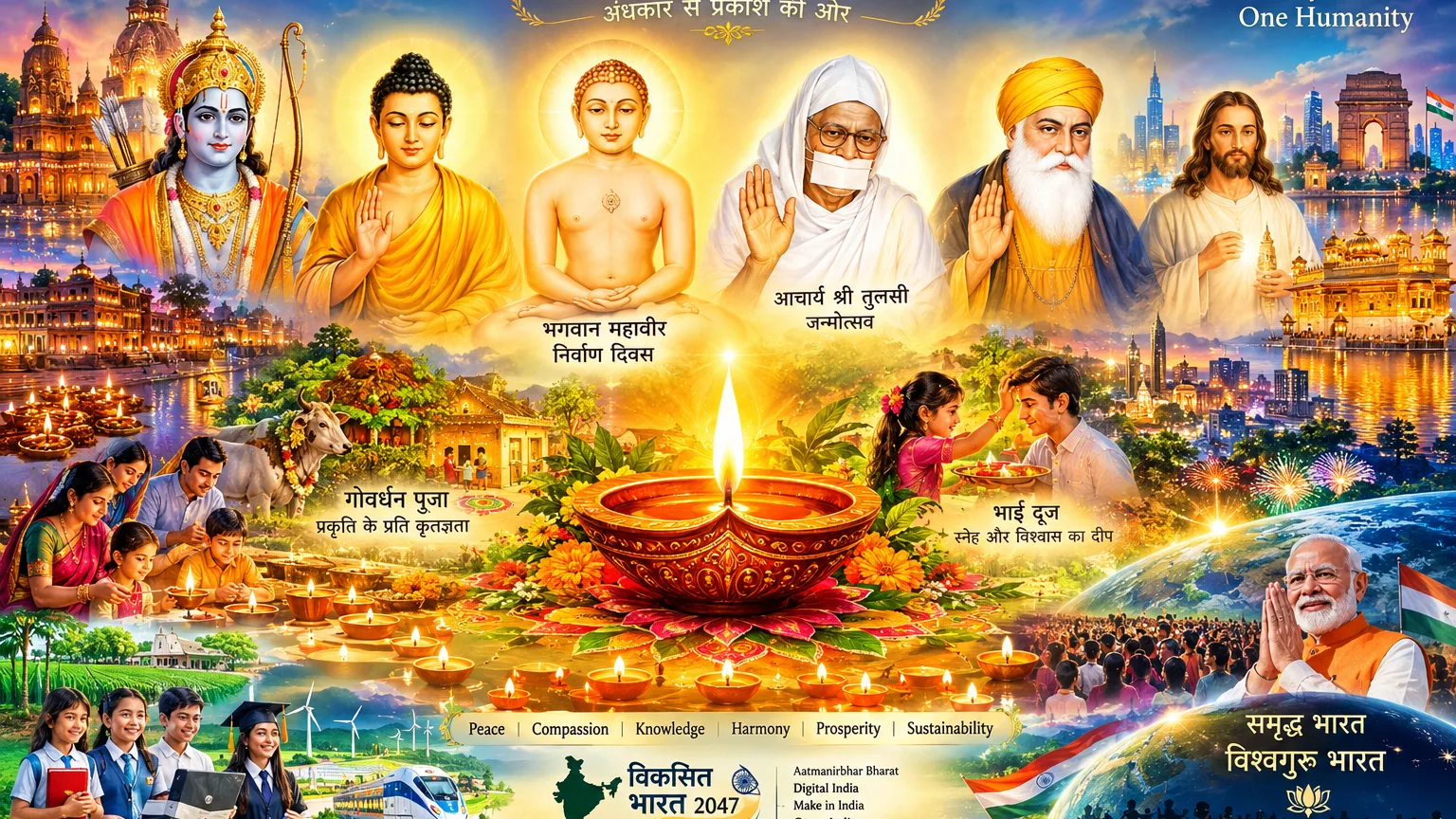
Today, there is a need to transform the Diwali lamp into a symbol of national resolve. One lamp for self-restraint. One lamp for non-violence. One lamp for environmental protection. One lamp for social harmony. One lamp for the dignity of women. One lamp for integrity. And one lamp for devotion to the nation. When millions of homes light millions of lamps together with these values, India's radiance will no longer remain confined to homes and marketplaces; it will illuminate the path of humanity. A lamp has a unique quality: it burns itself while giving light to others. This is the essential character of Indian culture. A civilisation inspired by the ideal of Vasudhaiva Kutumbakam—the world is one family—cannot view its own progress as separate from the welfare of the world. If India aspires to become a guiding force for humanity, it must offer the world not merely knowledge, but also the wisdom of balance; not merely a model of prosperity, but also a pathway to peace.
This Diwali, let us ask ourselves one question: What darkness still remains within me? Is it anger, greed, ego, jealousy, fear, insensitivity or indifference? For darkness does not disappear merely by condemning it. A small lamp has to be lit. The lamp teaches us another profound lesson: life does not demand escape from circumstances; it demands transformation. No matter how difficult the circumstances may be, human beings must never allow the inner flame to be extinguished. This Diwali, let us decorate not only our homes but also our hearts; let us beautify not only our doorsteps but also our consciousness; and along with the lights that rise into the sky, let us kindle the flame of inner illumination within ourselves. Because the greatest identity of a developed India will not be its shining roads or magnificent buildings, but its awakened citizens.
India is taking a new turn today. Its economy is touching new heights, its scientific achievements are crossing new frontiers, its young generation is opening doors to new possibilities, and India is establishing its role on the global stage with renewed confidence. In this transformative journey, the message of Diwali must also acquire a new meaning: Let the India outside become illuminated, and let the India within become awakened. Only then will Diwali cease to be merely a festival. It will become the new light of a New India, a renewed radiance of India's timeless civilisation, and India's declaration of a path of light for humanity. Let us, therefore, light one lamp in our homes and another within ourselves.
One lamp for prosperity and one for compassion. One lamp for development and one for wisdom. One lamp for progress and one for peace. One lamp for a stronger India and one for a more sensitive India. Because when the inner lamp is lit, only then does the outer light acquire its true meaning. And on the day when this inner light is kindled in the hearts of millions of Indians, India will not merely become developed—it will become a nation capable of showing the world how development can walk with wisdom, power can coexist with peace, and prosperity can flourish alongside compassion. That will be the true spirit of Diwali.