.png)

The 65th "Lakkhi Annakut" festival, held on November 9th at the renowned Hanuman Temple in Khole ke Hanuman ji Mandir, Jaipur, was honored by the Oxford Book of World Records with a certificate for the world's largest offering of 87.5 tons of Prasad to Hanuman ji and for the historic spiritual event of serving Prasad to over 222,030 people in a single day.

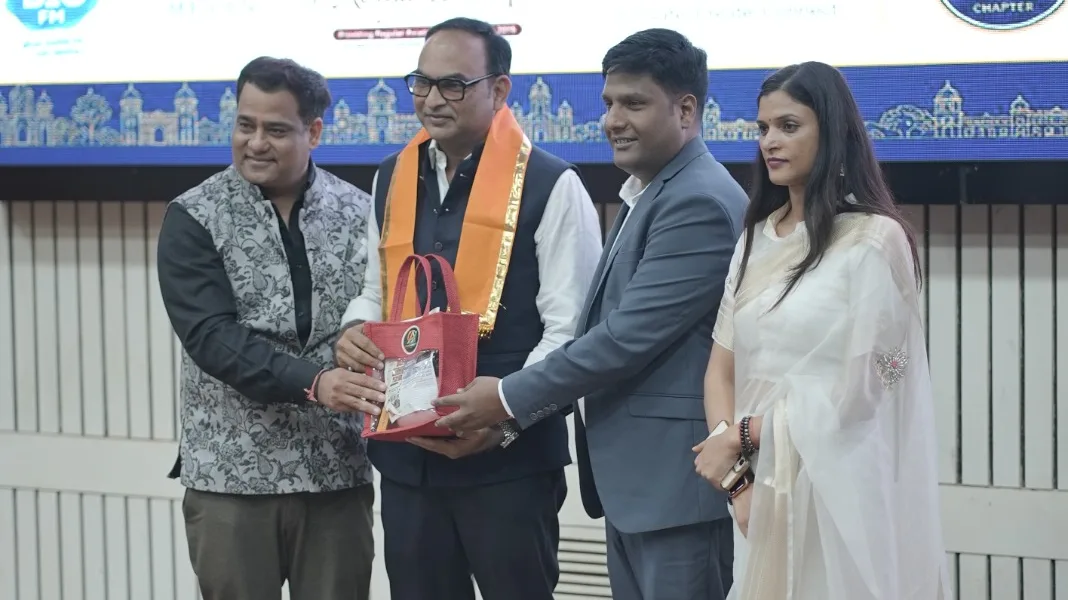
On Tuesday evening, the local team of the Oxford Book of World Records honored Brij Mohan Sharma, General Secretary of the Khole ke Hanuman ji Temple of Narwar Seva Samiti, with this certificate. The certificate is signed by Pankaj Harsh, President of the Oxford Book of World Records, Burghingham, United Kingdom, and Alok Sharma, Chairman.
The certificate stated that setting a world record for the world's largest Hanuman Bhog, serving 87.5 tons of prasad to over 2, 22,000 devotees in a single day, is a historic spiritual event that demonstrates immense devotion, service, and unity among devotees. This divine prasad symbolizes the faith and collective dedication to Shri Khole Hanumanji.
Temple Committee President Girdhari Lal Sharma stated that Annakut is celebrated annually at the Khole Hanumanji Temple located at Laxman-Dhungri in Jaipur. This year, on November 9, 2025, the 65th Lakh Annakut festival was held. Approximately 450 halwais (cooks) were employed for the event, preparing the prasad (Annakut) on 41 furnaces. The quantity of prasad was enormous, with approximately 800 quintals (over 8 tons) prepared. In addition to the temple complex, Annakut offerings were also offered in 61 other nearby temples. This prasad was distributed to devotees seated in rows within the temple premises.
A highlight of this festival was the display of "Chhappan Bhog" (56 types of dishes) this year, which included sweets, a variety of vegetables, pulses, and prasad items such as curd and curry. Various food items, including moong, moth, millet, rice, mixed vegetables, and puris, were offered. In addition to the Annakut offerings, religious activities such as prayers, special decorations, and bhajans and kirtans were also held in the temple.
The Annakut festival became not just a food celebration, but a symbol of devotion, service, and togetherness. Such an event erased differences between rich and poor, caste, and class, and allowed all devotees to sit together in rows and partake of the prasad, a message of religious equality and brotherhood. This event strengthened the religious unity, community spirit, and faith-cultural heritage of Jaipur, the Pink City, the capital of Rajasthan, and the surrounding region. The distribution of prasad and crowd management of such a large number of devotees occurred smoothly and without any security, sanitation, or traffic issues.
The "Lakkhi Annakut Festival" held at the Hanuman Temple in Khole, Jaipur, proved to be not only a religious celebration but also a massive event of faith, service, community, and cultural dedication. With over 450 confectioners, 800 quintals of prasad, and food for over 222,000 devotees, the scale is certainly extraordinary, placing it in the record category. This year's 65th Lakkhi Annakut Festival held at Jaipur's iconic Hanuman Temple in Khole has not only become a symbol of religious devotion but is also being called Rajasthan's grandest folk festival. This event further deepens the temple's social and cultural identity, where not only devotion but also the spirit of service and unity are clearly evident.
Annakut Festival: An Introduction
The Hanuman Temple of Khola, located on Lakshman Dungri in Jaipur, annually celebrates the Annakut Festival (Lucky Annakut) on the occasion of Govardhan Puja. The temple management committee celebrated the 65th anniversary of this sacred event on November 9, 2025. It is believed to be the largest Annakut festival in the region, with over 450 confectioners preparing a variety of dishes. Forty-one large ovens have been set up on the temple premises for the festival. Estimated ingredients include 1,500 kg of ghee, over 20 vegetables, curd-curry, and semolina pudding. A special Chhappan-Bhog (sixty-six bhog) group of 56 dishes will be prepared, which will be offered to devotees as offerings and prasad.
The scale of the prasad distribution will also be enormous. Over 2,22,000 devotees ate in rows. This festival isn't just a food gathering; it's a celebration of community and faith. Annakut offerings were made in the temple complex as well as in 61 other nearby temples, fostering a sense of religious unity and brotherhood in the surrounding community. Caste or economic discrimination is absent in the distribution of offerings. All devotees share the same row and partake, conveying a message of service and respect. This event is organized with religious devotion and a systematic approach to cleanliness and order. Teams from the district administration, police, municipal corporation, and Swachh Bharat Mission also cooperated during the festival.