
.png)
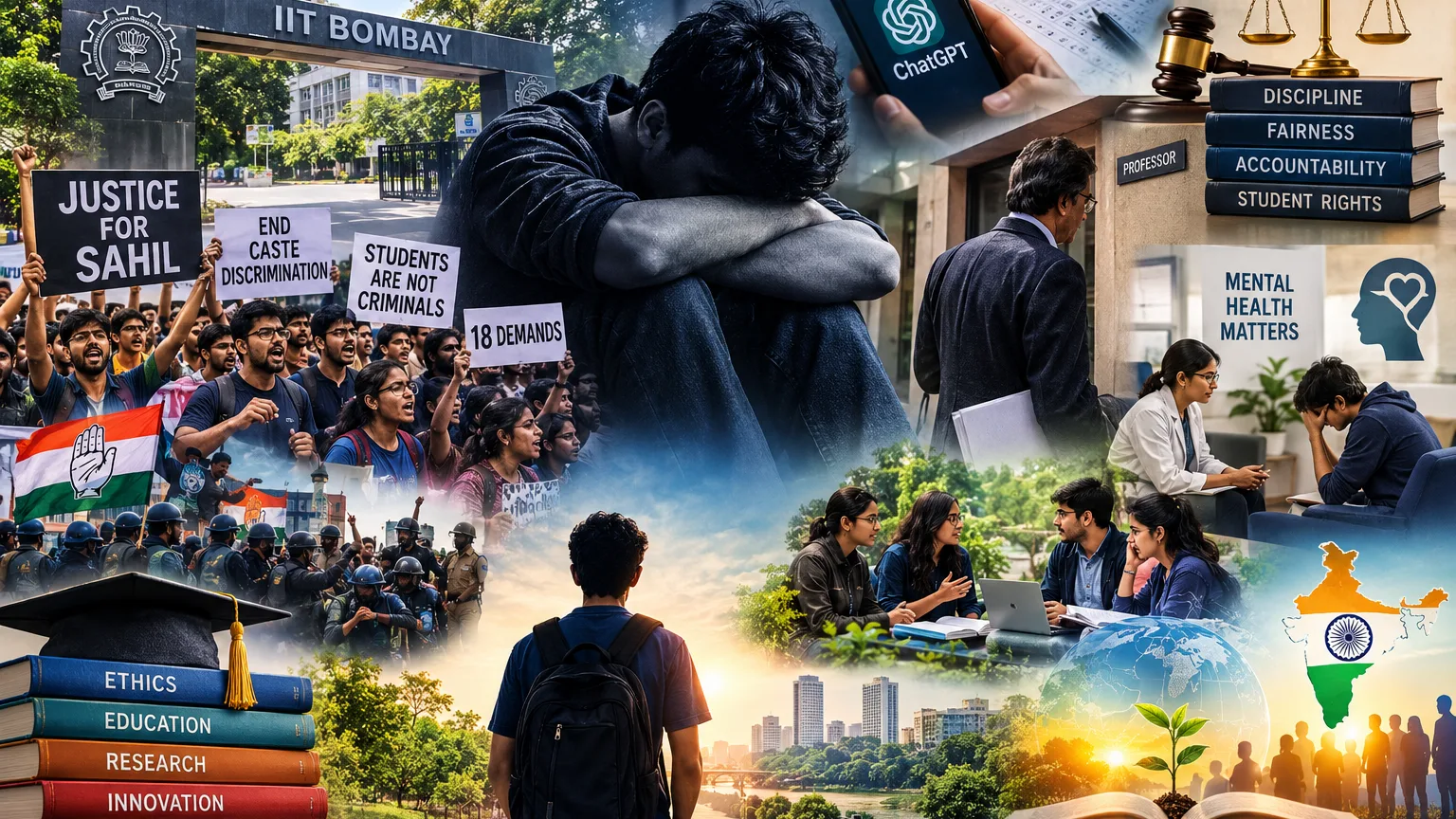
The tragic death by suicide of Sahil Wakode, a second-year B.Tech student in the Department of Energy Science and Engineering at IIT Bombay, has sent shockwaves across the country. The incident has triggered intense anger among students on the campus and has also drawn strong reactions from political parties and student organisations. Beyond the immediate circumstances of Sahil’s death, the episode has raised deeper questions about the growing academic and psychological pressures faced by students in some of India’s most prestigious institutions, the nature of student-faculty relationships, institutional accountability, and the safeguards available to vulnerable students. According to the allegations surrounding the incident, Sahil was caught using a mobile phone during an examination on September 18. The institute has stated that he allegedly attempted to upload the question paper to ChatGPT in an effort to cheat. Students and Sahil’s family, however, have raised serious questions about what happened after he was caught. Students have alleged that he was threatened with academic suspension for a year and asked to vacate his hostel, which they believe placed him under severe psychological pressure. These allegations remain matters for investigation, and the precise sequence of events leading to his death must be established through an impartial and credible inquiry. The matter has taken an even more serious turn because of allegations of caste-based harassment. Sahil’s parents, who belong to the Dalit community, have accused the IIT administration and the concerned professor of subjecting him to caste-based abuse and mental harassment. A police case has reportedly been registered against Professor Surya Narayan Dulla under provisions of the Scheduled Castes and Scheduled Tribes (Prevention of Atrocities) Act as well as for alleged abetment of suicide. These are serious allegations, and their truth or otherwise must be determined through due process rather than assumption or political assertion. The incident has also exposed the intensity of student anger on the IIT Bombay campus. More than 400 students reportedly participated in a prolonged protest near the main gate and the convocation hall, demanding transparency, accountability and action against those they believed were responsible. Under mounting pressure, IIT Bombay Director Professor Shirish Kedare signed an 18-point charter of demands submitted by the protesting students. Following the protests, Professor Surya Narayan Dulla was removed from the position of Dean for Administrative Affairs. At the same time, the faculty forum has reportedly expressed support for the professor, maintaining that he was performing his official duties. This contrasting set of claims underlines the need for an objective investigation capable of separating established facts from competing narratives. The institute has also accelerated certain hostel-safety measures, including replacing ceiling fans in hostel rooms with wall-mounted fans. While such measures may address immediate physical safety concerns, the larger issue is far more complex. Student safety cannot be reduced merely to physical infrastructure. It also involves emotional security, access to confidential counselling, responsible academic disciplinary procedures, sensitivity among faculty members, and a campus culture in which students can seek help without fear of humiliation or disproportionate consequences. The controversy has meanwhile moved beyond the campus. Youth Congress workers reportedly staged a protest outside the main gate of IIT Bombay, leading to the detention of some protesters by the police and increased security around the campus. Student organisations such as the Ambedkar Periyar Phule Study Circle and AIDSO have rejected the idea that the incident should be viewed merely as an individual academic failure. They have described it in much stronger terms and raised broader questions about the treatment and safety of students belonging to Dalit and other historically disadvantaged communities in IIT campuses. Such characteristics are political and organisational positions; they should be examined alongside verified evidence from the investigation. The most disturbing dimension of the episode is the larger question of institutional pressure. Students entering premier institutions such as IITs carry enormous academic expectations. They are often competing with exceptionally talented peers, facing demanding examinations, uncertain academic outcomes and intense pressure to secure their future. In such an environment, a disciplinary incident that might ordinarily be manageable can sometimes be experienced by a young student as a catastrophic threat to his entire future. This does not justify academic misconduct, if established, but it does underline the importance of ensuring that disciplinary processes are firm, proportionate, transparent and humane. The issue of mental health is equally significant. Students have questioned the effectiveness and accessibility of wellness and counselling services on the campus, particularly in light of reports that this was the third suicide at IIT Bombay within a period of roughly six to seven months. Each such incident demands careful examination—not only of the circumstances surrounding the individual's death but also of whether students are able to access meaningful psychological support when they are under extreme stress. A counselling centre on paper is not enough; students must trust the system, know how to approach it and feel confident that seeking help will not affect their academic standing or social dignity. Another serious concern relates to allegations of caste discrimination. Students from reserved and historically marginalised communities have repeatedly raised concerns in educational institutions about social isolation, discrimination and a lack of belonging. Such concerns cannot be dismissed without examination. At the same time, allegations in an individual case must be established through evidence and due investigation. The answer lies neither in denying the possibility of discrimination nor in declaring guilt before the facts are established. It lies in creating transparent mechanisms through which complaints can be independently examined and students can obtain protection and justice where violations are proven. The students have also questioned the handling of previous suicide cases on the campus, alleging that investigation reports were not made public and that institutions sometimes attempt to protect their reputation rather than confront uncomfortable truths. Whether these allegations are justified is itself a matter requiring verification. But the demand for transparency is understandable: when a student dies within an institution, the response cannot end with condolences. There must be an honest effort to understand what happened, what warning signs may have been missed and whether institutional practices contributed to the circumstances. The investigation, now reportedly being handled by the Mumbai Police Crime Branch, therefore assumes enormous importance. It must establish the complete chain of events between the examination incident and Sahil’s death, examine the allegations made by his family and students, assess the conduct of the concerned individuals, and determine whether any criminal or institutional wrongdoing occurred. The investigation should be allowed to proceed without political pressure, prejudice or premature conclusions. The IIT Bombay tragedy is ultimately not only about one examination, one disciplinary action or one student. It compels society to reconsider what it expects from institutions that educate the country's brightest young minds. Excellence in education cannot be measured only by rankings, placements, research output or examination results. A truly outstanding institution must also be judged by how safely, respectfully and compassionately it treats its students when they make mistakes, face failure or find themselves in crisis. Academic discipline is necessary, but discipline without sensitivity can become oppressive; freedom without responsibility can undermine academic integrity. The challenge before premier institutions is to maintain both. Students must understand the consequences of misconduct, while institutions must ensure that those consequences remain proportionate, transparent and consistent with human dignity. Sahil Wakode’s death should therefore become an occasion for introspection rather than merely another episode of protest and controversy. The truth must emerge through a credible investigation, accountability must follow wherever wrongdoing is established, and institutions must learn from every failure. Most importantly, every student must know that a mistake, an examination failure or an academic disciplinary proceeding is not the end of life. Education should open doors to the future—not make a young person feel that all doors have closed.
India
Sahil Wakode’s Death: A Wake-Up Call for India’s Premier Educational Institutions
Lalit Gargg
Related stories
BHIM Payments App Introduces MyUPI to Simplify UPI Support, Mandate Management and Safety Controls for Users
Udaipur : NPCI BHIM Services Limited (NBSL), a wholly owned subsidiary of the National Payments Corporation o…

Hon’ble Supreme Court dismisses SLP Petition by Sharanam AoA for granting of additional FAR to Great Value Ekanam
New Delhi: In a significant legal development for Great Value Realty, the Hon’ble Supreme Court of India has…

MIA BY TANISHQ EXPANDS DELHI-NCR PRESENCE WITH THE LAUNCH OF TWO NEW STORES IN PASCHIM VIHAR AND VASANT KUNJ
New Delhi: Mia by Tanishq, one of India’s leading fine jewellery brands, today strengthened its presence in t…

Merck Foundation in Partnership with African and Asian First Ladies Invites Applications for Their 2026 Fashion, Film and Song Awards More Than a Mother and Diabetes and Hypertension
DAKAR -- Merck Foundation (https://Merck-Foundation.com/), the German not-for-profit organization, in par…