.png)
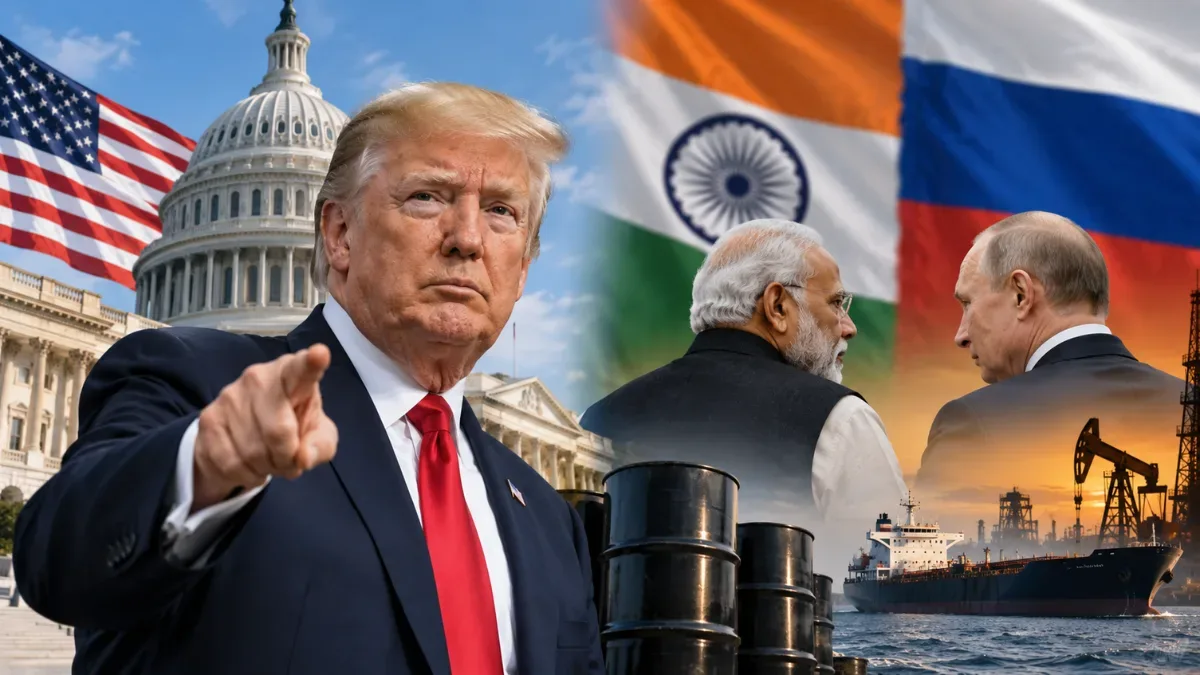
In global politics, power is determined not merely by military strength or economic size, but also by how a major power chooses to exercise its influence. Under President Donald Trump, the United States has increasingly used tariffs and economic sanctions as instruments of foreign policy. The latest legislation targeting countries that continue to purchase Russian oil and gas is another indication of this approach. The U.S. House of Representatives passed the measure on September 16, 2026, by a 262–159 vote. The legislation authorizes the President to impose tariffs of up to 100 percent on major buyers of Russian energy; it does not, by itself, automatically impose a 100 percent tariff on India. For India, the issue is significant because Russia remains an important source of crude oil. According to S&P Global data, India imported around 1.6 million barrels per day of Russian crude in August 2026, making it the largest importer among the major Russian crude buyers listed in the data. Any decision by Washington to exercise the new authority could therefore affect Indian exports to the American market and could also create pressure on India’s energy costs. New Delhi has made clear that it will protect its trade and economic interests while safeguarding energy security.
The larger question, however, goes beyond this particular legislation: Are tariffs still primarily instruments of trade policy, or are they increasingly becoming tools for compelling other countries to align their foreign-policy choices with Washington? The distinction matters because the consequences extend well beyond bilateral trade. India and the United States have substantial economic ties. America remains an important destination for Indian exports, while American companies and consumers also benefit from access to Indian goods and services. Consequently, very high additional tariffs would not affect India alone. They could also influence American importers, consumers and businesses connected to bilateral supply chains. The economic relationship creates interdependence, meaning that tariff escalation can generate costs on both sides.
India therefore faces a twofold challenge. The first is to preserve the competitiveness of its exports in the American market. The second is to maintain energy security. A sudden reduction in Russian crude imports could force Indian refiners to seek alternative supplies, potentially at higher prices, particularly when global energy markets are already exposed to geopolitical disruptions. Indian refiners have also indicated that replacing Russian crude rapidly could be difficult because of the scale involved and the availability of alternative supplies. At the same time, Washington has its own calculation to make. Excessive tariffs on major energy-importing countries could have consequences for global oil flows, prices and the economic interests of American businesses. The legislation therefore includes scope for presidential discretion and waivers where national interests are involved.
This is where India’s policy of strategic autonomy assumes greater importance. India has neither sought to sever its relations with Russia nor subordinated its economic interests to the priorities of any single power. Its approach has been to maintain relationships with multiple major powers while diversifying energy supplies and protecting national interests. India’s engagement with the BRICS framework provides an important illustration of this approach. At the 18th BRICS Summit in New Delhi on September 12–13, 2026, member countries adopted the 140-point New Delhi Declaration. The declaration emphasized economic cooperation and explored practical mechanisms for more efficient cross-border payments, including greater use of BRICS members’ local currencies for trade settlements and investment.
It is important, however, not to exaggerate what this means. BRICS is not currently replacing the U.S. dollar with a common currency. The New Delhi Declaration does not propose a single BRICS currency. Instead, it supports practical efforts to facilitate cross-border payments and expand the use of local currencies while respecting national priorities. The dollar remains deeply embedded in global trade and finance. Yet if countries gradually expand bilateral settlements in their own currencies and develop alternative payment mechanisms, the international financial system could become more diversified over time. India-Russia economic relations offer a practical example. The development of alternative payment arrangements demonstrates that countries can adapt their financial mechanisms when conventional channels are affected by sanctions or geopolitical restrictions. This does not mean that the dollar will suddenly lose its global importance. Rather, it indicates that countries are seeking additional options to reduce vulnerability to external financial pressure.
BRICS should therefore not automatically be interpreted as an anti-American platform. Its current agenda encompasses economic cooperation, development, payments, investment, technology and reform of multilateral institutions. The New Delhi Declaration itself emphasizes a more representative and inclusive international order rather than the replacement of one dominant power by another. For India, this diversification of relationships is strategically significant. The objective is not to choose between the West and the non-West, but to retain constructive engagement with both. India’s strength lies precisely in its ability to maintain dialogue with the United States and Europe while simultaneously engaging Russia, the Gulf countries, BRICS members, ASEAN, Africa and other emerging economic partners.
The most consequential long-term effect of America’s tariff strategy may therefore not be the tariff itself, but its impact on trust and policy predictability. When tariffs and sanctions are repeatedly used as instruments of geopolitical pressure, other countries have an incentive to search for alternative markets, supply chains, payment systems and sources of energy. This does not mean that the United States will suddenly lose its economic or strategic influence. It does mean that other countries may increasingly seek to reduce their exposure to any single power. For India, the appropriate response is not simply confrontation or accommodation. It is strategic preparation. The American market remains extremely important, making continued negotiations and diplomatic engagement essential. At the same time, India needs to expand export opportunities in Europe, West Asia, Africa, ASEAN, Russia and other emerging markets. Strengthening domestic manufacturing, improving export competitiveness, diversifying energy supplies and developing technological capabilities can reduce vulnerability to external shocks.
The world of 2026 is substantially more complex than the unipolar environment that followed the Cold War. China’s economic weight, India’s expanding market, Russia’s energy resources, West Asia’s strategic importance and the growing voice of the Global South are contributing to a more dispersed global power structure. The BRICS summit in New Delhi reflected this changing environment, with practical cooperation on economic, financial and developmental issues rather than an immediate attempt to create an alternative global monetary system. For the United States, too, the present moment carries an important strategic lesson. American economic strength, technological leadership, the international role of the dollar and its network of alliances remain significant. But the long-term effectiveness of these strengths depends partly on whether they are used to build confidence and partnerships or primarily as instruments of pressure.
India, meanwhile, need not view every American move as a threat, nor should it underestimate the economic consequences of a major tariff escalation. The sensible course is to remain calm, negotiate firmly, diversify intelligently and protect national interests without closing the doors of cooperation. The emerging global order is not necessarily moving toward a world without American influence. It is moving toward a world in which more countries are seeking multiple options rather than dependence on a single power. That distinction is crucial. For India, the challenge is therefore larger than a possible American tariff. It is about strengthening its position in a rapidly transforming global economy. If India can combine energy security, export diversification, technological capability, domestic manufacturing and constructive multilateral engagement, its ability to withstand external economic pressure will grow substantially. America may possess powerful instruments of pressure, but India possesses an equally important strategic asset—the ability to create choices. In a multipolar world, national resilience does not come from withdrawing from global relationships; it comes from having enough relationships, markets and strategic options to remain free to choose.